
Key Takeaways
- Cats show skin trouble in only a few ways: tiny scabs, hair loss from overgrooming, scratches on the head and neck, or raised red sores. The same look can have many causes, so a vet usually needs to test.
- Allergies cause most itchy skin in cats. Flea allergy is the most common allergy. Indoor cats can get fleas too, and you may never see one.
- Treat every pet in the home for fleas, year-round, with products made for cats. Never put a dog flea product on a cat. Many contain permethrin, which can kill cats.
- Hair loss from stress alone is less common than many people think. In one study of 21 cats, 19 had a medical cause, usually allergy.
- See a vet soon for any new lump, a sore that won't heal, or patchy hair loss that could be ringworm, which people can catch.
Cat Skin Problem Checker
Pick what you see on your cat and answer a few questions. You'll get the most likely causes, how soon to see a vet, and where to read more. This checker can't diagnose your cat. Many skin problems look alike, so your vet may need tests to find the cause.
The 4 Ways Cat Skin Problems Show Up
Cats react to many different skin problems in just a few ways. Vets call these "reaction patterns." They describe what the skin looks like, not what caused it. In a study of 502 itchy cats, none of the patterns pointed to one specific cause [3]. That's why the cause usually has to be found step by step.
1. Miliary dermatitis: tiny scabs
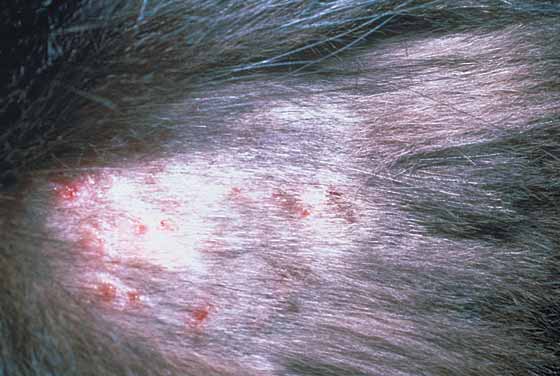
Many small crusted bumps that feel like grains of millet or sand, usually along the back, neck and face [6][8]. You'll often feel them before you see them. Flea allergy is the most common trigger, but food allergy, environmental allergy, mites and infection can cause it too [6][21]. Read more about miliary dermatitis.
2. Hair loss from overgrooming
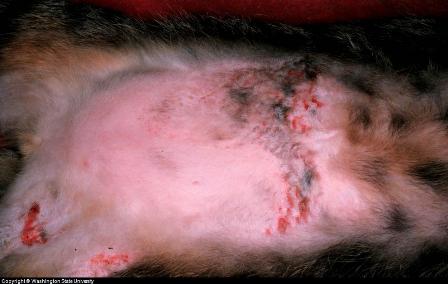
Thin or bald patches, often on both sides of the body, on the belly, inner thighs and flanks. The skin underneath usually looks normal. The hair isn't falling out. The cat is licking it off, often in private [6]. Under a microscope, these hairs are broken rather than shed [6]. Read more about why cats lose hair.
3. Head and neck itch
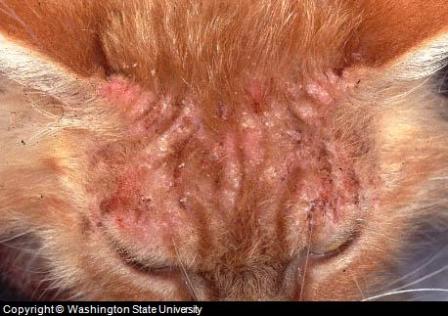
Intense scratching of the face, ears and neck, leaving raw scratches, scabs and open sores, which can become infected [6]. It's common with food allergy and environmental allergy [6][13]. Read more about food allergies in cats.
4. Eosinophilic granuloma complex: raised red sores
Three kinds of sores linked to allergy [14]:
- Indolent ulcer: a well-defined sore on the upper lip, sometimes called a "rodent ulcer."
- Eosinophilic plaque: raised, raw, very itchy patches that can appear anywhere on the body.
- Eosinophilic granuloma: firm lumps or lines, often on the back of the thighs, the chin ("fat chin") or in the mouth.
These are signs, not diseases. Flea allergy is the most common trigger [14].
What You See and What It May Mean
Use this table as a starting point to talk with your vet, not as a diagnosis.
| What you see | Most likely causes | Other possibilities |
|---|---|---|
| Tiny scabs on the neck, back or tail base | Flea allergy [7][8] | Food or environmental allergy, mites, lice, ringworm, bacterial infection [6][16][18][21][38] |
| Scratches and sores on the head, face or neck | Food allergy or environmental allergy, flea allergy [6][7][13] | Ear mites, scabies mites, ringworm, mosquito bite allergy, pemphigus (an autoimmune disease) [15][16][18] |
| Bald belly, inner thighs or sides, with normal skin | Overgrooming from allergy [3][6] | A contagious mite called Demodex gatoi, pain, stress (only after medical causes are ruled out) [17][29] |
| Round or patchy bald spots with flaky skin or broken hairs | Ringworm, especially in kittens, longhaired cats and cats from shelters [18][20] | Mites, bacterial infection, overgrooming [16][21] |
| Dandruff or flaky skin | Not grooming well because of weight, arthritis or illness; Cheyletiella mites ("walking dandruff") [16][32][33]. See cat dandruff. | Ringworm, allergy, hyperthyroidism, diabetes, kidney disease, and rarely skin lymphoma [20][31][32] |
| Black specks in the fur | Flea dirt, which turns red-brown on a damp paper towel [7][8] | Ordinary dirt, which stays black |
| Blackheads on the chin | Feline chin acne [24] | Yeast infection, mites or ringworm; eosinophilic granuloma if the chin is swollen [14][24] |
| Raised red patches, or a sore on the upper lip | Eosinophilic granuloma complex, usually from allergy [14] | A tumor, if a lip sore is on one side and doesn't heal [14] |
| A lump under the skin | Abscess, if painful and warm after a fight; mast cell tumor or another skin tumor [22][27] | Injection-site sarcoma at a vaccine site; eosinophilic granuloma [14][27][28] |
| Painful swelling, pus, fever | Abscess from a bite wound [22] | A foreign object or unusual infection if it keeps draining [22] |
| Ear scratching, head shaking, dark ear debris | Ear mites [16] | Yeast or bacterial ear infection, allergy |
| Crusts or sores on the ear tips or nose of a white cat | Sun damage, which can turn into skin cancer [26] | Mosquito bite allergy, pemphigus, scabies mites [15][16] |
| Greasy fur or hair loss on top of the tail base | Stud tail [23] | Seborrhea [33] |
| Skin that tears with gentle handling | Cushing's disease or skin fragility syndrome [30] | Liver or pancreas disease [30] |
Common Causes of Skin Problems in Cats
Between 6% and 15% of cats seen by vets have at least one skin disease, and many have more than one [1]. In general practice, abscesses, fleas and ear infections are the most common skin diagnoses [2]. In itchy cats seen by dermatologists, the leading causes were flea allergy (29%), environmental allergy (20%) and food allergy (12%) [3].
Allergies
- Flea allergy dermatitis. An allergy to flea saliva and the most common allergic skin disease of cats [6]. Cats groom fleas away, so you may never see one [7].
- Food allergy. Itching that doesn't change with the seasons, often on the head and neck. Most cats show signs before age 2. Common triggers are fish, beef, chicken and dairy [13]. Read more about food allergies.
- Environmental allergy (feline atopic skin syndrome). An allergy to things like pollen, dust mites and mold. Vets now call it feline atopic skin syndrome, or FASS. It usually starts before age 5 and is diagnosed only after fleas, mites, infection and food allergy are ruled out [4][6]. Read more about cat allergies.
- Mosquito bite allergy. Crusted, itchy sores on the ear flaps and nose of cats that go outside [15].
Parasites
- Fleas, the most common external parasite of cats in North America [9]. See fleas on cats.
- Ear mites, especially common in cats. All pets in contact need treatment [16]. See ear mites in cats.
- Cheyletiella ("walking dandruff"), very contagious mites that cause scaling along the back. People are often bitten too [16].
- Demodex gatoi, a mite that spreads between cats and causes itching and overgrooming that can look like allergy [16][17].
- Scabies mites (Notoedres), rare but highly contagious, with crusts starting on the ears and head [16]. See mange in cats.
- Lice, now uncommon, mostly in older, longhaired or stray cats that can't groom well [38].
Infections
- Ringworm, a fungal infection, not a worm. It causes patchy hair loss with scaling and broken hairs, often starting on the face, ears and paws, and it usually isn't very itchy [18][20]. People can catch it [19]. See ringworm in cats.
- Abscesses from bite wounds. The punctures seal over and trap bacteria, causing a painful swelling and fever [22]. See cat wound care.
- Bacterial infections, which in cats are usually a result of allergy, parasites or another illness [21]. Yeast can also infect the skin, for example with chin acne [24].
Other causes
- Chin acne: blackheads on the chin, often lifelong. Mild cases may need no treatment [24]. See cat chin acne.
- Stud tail: greasy fur and blackheads on top of the tail base, most common in unneutered males but possible in any cat [23].
- Sun damage and skin cancer: white cats and cats with white ears can develop sunburned ear tips, nose and eyelids that can turn into squamous cell carcinoma [26]. See skin cancer in cats.
- Lumps and tumors: mast cell tumors are the second most common skin tumor in cats. Benign and cancerous lumps can look alike, so any new lump should be checked [27].
- Illness elsewhere in the body: hyperthyroidism can make the coat unkempt or greasy, and Cushing's disease can make skin thin and fragile [30][31].
- Stress: "psychogenic" hair loss from stress does happen but is uncommon. In one study of 21 cats referred for it, only 2 had a purely behavioral cause [29].
Start with Fleas, Even for Indoor Cats
Because flea allergy is so common and fleas are so easy to miss, vets usually rule out fleas first [7].
- Check with a flea comb. Comb your cat over a white surface, especially the neck and base of the tail. Put any black specks on a damp paper towel. Flea dirt (flea droppings) turns red-brown [7][8].
- Treat every dog and cat in the home, year-round, and treat the home too. Wash bedding and vacuum well. Full control can take 2 to 3 months [8][9].
- Use products labeled for cats, chosen with your vet [10].
Never use a dog flea product on a cat. Many dog spot-ons contain 45% to 65% permethrin. Merck warns that permethrin can be highly toxic to cats, causing muscle twitching and seizures [10]. Poisoned cats often have tremors [39]. Cats can also be poisoned by grooming or sleeping next to a dog that was just treated [11]. If this happens, go to a vet right away.
How Vets Find the Cause
Finding the cause of a cat's skin problem often takes several steps [1][6]. Your vet may use:
- Flea combing and a trial of strict flea control for every pet in the home [7]
- Skin scrapings and tape tests to look for mites [16]
- A look at plucked hairs under the microscope, which shows whether hair is being licked off or falling out [6]
- A Wood's lamp and fungal culture or PCR for ringworm. No single ringworm test is perfect [18]
- Cytology, looking at skin cells for bacteria and yeast [21]
- An elimination diet trial, the only reliable way to diagnose food allergy. Your cat eats only a prescription or novel-protein diet for at least 8 weeks, sometimes longer, with no other foods or treats [12][13]. Never starve a cat into eating a new food, which can cause serious liver disease [13].
- Allergy testing, used to choose allergy shots after environmental allergy has been diagnosed. On its own, it can't diagnose allergy [6].
- Fine-needle aspirate or biopsy for lumps, sores that won't heal, and unusual cases [26][27]
- Blood tests for thyroid disease, diabetes and FIV/FeLV, especially after bite wounds or repeat infections [21][22]
Vaccine-site lumps: the 3-2-1 rule
Small swellings after a vaccine are common and usually go away. Feline vaccination guidelines advise a biopsy if a lump is still there 3 months after the vaccine, is larger than 2 cm (about 3/4 inch), or is still growing 1 month after the vaccine [28]. Injection-site sarcomas are rare, about 1 in 10,000 vaccine doses [27].
Treatment
Treatment depends on the cause. Your vet will tell you which medicines and doses are right for your cat.
- Flea allergy: year-round flea control for every pet in the home [9].
- Food allergy: lifelong avoidance of the trigger food, found through the diet trial [13].
- Environmental allergy: anti-itch medicine and sometimes allergy shots or drops. A 2021 review found good evidence in cats only for glucocorticoids (steroids) and ciclosporin [5]. Oclacitinib (Apoquel) is approved for dogs and is used off-label in cats, without long-term safety data [6]. Allow about a year to judge allergy shots [6].
- Ringworm: antifungal medicine by mouth plus whole-body dips or shampoos, and cleaning the home. Expect at least 6 weeks of treatment [18][20].
- Mites: prescription parasite treatment for every pet in contact [16].
- Abscesses: draining, flushing, antibiotics and pain relief [22].
- Bacterial and yeast infections: medicated shampoos or wipes, and antibiotics or antifungals when needed, plus treating the underlying cause [21].
- Sun damage and skin cancer: surgery or other cancer treatment, and keeping the cat out of strong sun [26].
Cat Health Guide earns a commission if you use JustAnswer through this link.
Home Care: What Helps and What to Avoid
| Home measure | What the evidence shows | Our verdict |
|---|---|---|
| Year-round flea control for all pets | The first step for almost every itchy cat [7][9]. | Do it. |
| Daily brushing | Helps cats with dandruff spread skin oils, especially cats that can't groom well [32]. | Helpful. |
| Omega-3 fatty acids (fish oil) | Weak evidence. A 2021 review rated them low to moderately effective for allergic cats [5][6]. | May help a little alongside treatment. Ask your vet. |
| Coconut oil or other oils on the skin | We found no studies of coconut oil on cats' skin. Cats groom off and swallow what you apply [34]. | No evidence. Ask your vet first. |
| Tea tree oil and other essential oils | Merck says concentrated essential oils should never be applied directly to pets. Cats are especially sensitive [34]. | Never use. |
| Human creams (pain-relief, anti-itch, numbing) | Cats lick creams off, and some ingredients, such as NSAID pain-relief creams and lidocaine, are especially dangerous to cats [35][36]. | Don't use without your vet's OK. |
| Hydrogen peroxide on wounds | Can delay healing [22]. | Don't use. Ask your vet how to clean a wound. |
| Squeezing chin blackheads, human acne products | Irritate the skin and can cause harm [25]. | Don't. |
| Homeopathic remedies | The UK's veterinary regulator says homeopathy has no recognized body of evidence [37]. | Don't use in place of treatment. |
What the Research Shows
- Flea allergy is the biggest single cause of itch. In 502 itchy cats seen by dermatologists in several countries, 29% had flea allergy, 20% environmental allergy and 12% food allergy. The skin's appearance didn't predict the cause [3].
- Food trials need about 8 weeks. About 80% of food-allergic cats improved within 6 weeks and about 90% within 8 weeks [12].
- New names for cat allergies. In 2021, veterinary dermatologists adopted the term feline atopic skin syndrome (FASS) and agreed it can be diagnosed only after fleas, parasites, infection and food allergy are ruled out [4].
- Only two anti-itch treatments have good evidence in cats. A 2021 systematic review found good evidence only for glucocorticoids and ciclosporin [5].
- "Stress" hair loss is usually medical. Of 21 cats referred for presumed stress-related hair loss, 76% had a medical cause, mostly allergy, and another 14% had a medical cause plus a behavioral one. Only 2 cats had a purely behavioral cause [29].
- Abscesses and fleas lead in everyday practice. In UK general practices, the most common skin diagnoses in cats were abscesses, flea infestation and ear infections [2].
Questions Owners Ask
Why does my cat have scabs on its neck?
Usually allergy. Flea allergy is the most common cause, followed by environmental and food allergy [3][6]. Tiny scabs on the neck and back are typical of flea allergy [8]. Ear mites and ringworm are also possible [16][18].
What is miliary dermatitis in cats?
A pattern, not a disease: many tiny crusted bumps, like millet seeds, usually along the back and neck. Flea allergy is the most common trigger, but food allergy, environmental allergy, mites and infection can cause it too [6][8][21].
Why is my cat losing hair?
Hair loss in cats is very often from overgrooming because of itching, usually from allergy [6][29]. Other causes include ringworm, mites, stud tail, hyperthyroidism and Cushing's disease [17][18][23][30][31]. Hair loss from stress alone is uncommon [29].
What does ringworm look like on a cat?
Patchy, often round hair loss with flaky skin, crusts and broken hairs. It often starts on the face, ears and paws and usually isn't very itchy. Some cats carry it without any signs [18][19][20].
Can humans catch cat skin conditions?
Some, yes. Ringworm is the main one, and people can easily be infected [19]. Cheyletiella mites often bite people, and flea bites cause itchy rashes [9][16]. Allergies, acne and most tumors aren't contagious.
Why does my cat have dandruff?
Often because the cat can't groom well, from extra weight, arthritis or illness such as kidney disease or diabetes. Other causes include Cheyletiella mites, ringworm, allergy and hyperthyroidism [16][32][33]. See your vet if it's more than a few flakes or comes with itching or hair loss [32]. Read our full guide to cat dandruff.
How can I tell if my cat has fleas if I can't see them?
Cats groom fleas away [7]. Comb over a white surface with a fine flea comb, then put any black specks on a damp paper towel. Flea dirt turns red-brown [7][8].
What is cat chin acne?
Blackheads on the chin and lower lip that give a "dirty chin" look. The cause is unknown and it's often lifelong. Swelling, pain or pus means infection and needs a vet. Don't squeeze, and don't use human acne products [24][25].
Can I put coconut oil on my cat's skin?
We found no studies showing it helps, and cats groom off and swallow whatever you apply. Ask your vet before putting anything on your cat's skin, and never use essential oils such as tea tree oil [34].
Can I use a dog flea treatment on my cat?
No. Many dog products contain permethrin, which can be highly toxic to cats and cause muscle twitching, tremors and seizures [10][39]. Keep cats away from dogs that were just treated [11].
Why does my white cat have scabs on its ear tips?
Probably sun damage. Over time it can become squamous cell carcinoma, a skin cancer. See your vet promptly about any sore that won't heal [26].
My cat has a lump where it was vaccinated. Should I worry?
Small swellings are common and usually go away. Have your vet check it if it's still there 3 months later, is larger than 2 cm, or is still growing 1 month after the vaccine [28].
How long does a food trial take for a cat?
Usually at least 8 weeks of a strict prescription or novel-protein diet. Most food-allergic cats improve within 6 to 8 weeks [12][13].
Have a question about your cat's skin? Ask it in the form below. Questions are answered by Cat Health Guide editors. Related: flea control for cats, hot spots, cat skin allergies.
Sources
- Cornell Feline Health Center. Feline Skin Diseases.
- Hill PB, Lo A, Eden CAN, et al. Survey of the prevalence, diagnosis and treatment of dermatological conditions in small animals in general practice. Vet Rec. 2006;158(16):533-539. Full text
- Hobi S, Linek M, Marignac G, et al. Clinical characteristics and causes of pruritus in cats: a multicentre study on feline hypersensitivity-associated dermatoses. Vet Dermatol. 2011;22(5):406-413. doi:10.1111/j.1365-3164.2011.00962.x
- Santoro D, Pucheu-Haston CM, Prost C, et al. Clinical signs and diagnosis of feline atopic syndrome: detailed guidelines for a correct diagnosis. Vet Dermatol. 2021;32(1):26-e6. doi:10.1111/vde.12935
- Mueller RS, Nuttall T, Prost C, et al. Treatment of the feline atopic syndrome: a systematic review. Vet Dermatol. 2021;32(1):43-e8. doi:10.1111/vde.12933
- Hoff S. Feline Atopic Skin Syndrome. Merck Veterinary Manual, 2026.
- Gentry C. Flea Allergy Dermatitis in Dogs and Cats. Merck Veterinary Manual, 2026.
- Dryden MW. Fleas of Cats. Merck Veterinary Manual (Pet Owner Version), 2026.
- Companion Animal Parasite Council. Fleas.
- Dryden MW. Ectoparasiticides Used in Small Animals. Merck Veterinary Manual, 2024.
- American Association of Feline Practitioners. Permethrin Poisoning and Cats.
- Olivry T, Mueller RS, Prélaud P. Critically appraised topic on adverse food reactions of companion animals (1): duration of elimination diets. BMC Vet Res. 2015;11:225.
- White SD, Moriello KA. Allergies of Cats. Merck Veterinary Manual (Pet Owner Version), 2024.
- Moriello KA. Eosinophilic Skin Diseases in Cats. Merck Veterinary Manual, 2025.
- Tomich L. Allergy in Dogs and Cats (Diseases of the Pinna). Merck Veterinary Manual, 2026.
- Dryden MW. Mite Infestation (Mange, Acariasis, Scabies) of Cats. Merck Veterinary Manual (Pet Owner Version), 2026.
- Torres SMF. Feline Demodicosis. Small and Large Animal Dermatology Handbook. University of Minnesota, 2025.
- Moriello KA, Coyner K, Paterson S, Mignon B. Diagnosis and treatment of dermatophytosis in dogs and cats: Clinical Consensus Guidelines of the World Association for Veterinary Dermatology. Vet Dermatol. 2017;28(3):266-e68. doi:10.1111/vde.12440
- Frymus T, Gruffydd-Jones T, Pennisi MG, et al. Dermatophytosis in cats: ABCD guidelines on prevention and management. J Feline Med Surg. 2013;15(7):598-604. doi:10.1177/1098612X13489222
- Cornell Feline Health Center. Ringworm: A Serious but Readily Treatable Affliction.
- Clark MD. Pyoderma in Dogs and Cats. Merck Veterinary Manual, 2025.
- VCA Animal Hospitals. Wounds: Fight Wound Infections in Cats.
- VCA Animal Hospitals. Stud Tail (Tail Gland Hyperplasia) in Cats.
- Torres SMF. Feline Acne. Small and Large Animal Dermatology Handbook. University of Minnesota, 2025.
- Texas A&M College of Veterinary Medicine. Managing Feline Acne. 2019.
- Roman N. Disorders of the Outer Ear in Cats. Merck Veterinary Manual (Pet Owner Version), 2026.
- Villalobos AE. Tumors of the Skin in Cats. Merck Veterinary Manual (Pet Owner Version), 2026.
- AAHA/AAFP. 2020 AAHA/AAFP Feline Vaccination Guidelines: Adverse Postvaccination Reactions.
- Waisglass SE, Landsberg GM, Yager JA, Hall JA. Underlying medical conditions in cats with presumptive psychogenic alopecia. J Am Vet Med Assoc. 2006;228(11):1705-1709. Summary
- White SD. Whole-Body Disorders That Affect the Skin in Cats. Merck Veterinary Manual (Pet Owner Version), 2024.
- Cornell Feline Health Center. Hyperthyroidism in Cats.
- Texas A&M College of Veterinary Medicine. Don't Brush Off Feline Dandruff. 2020.
- VCA Animal Hospitals. Seborrhea in Cats.
- Benson K. Toxicoses From Essential Oils in Animals. Merck Veterinary Manual, 2025.
- Stern L. Toxicosis in Animals From Human Topical Agents. Merck Veterinary Manual, 2025.
- ASPCA. Topical Creams Can Pose Danger to Pets. 2015.
- Royal College of Veterinary Surgeons. College Publishes Complementary Medicines Statement. 2017.
- Thomas JE. Lice of Cats. Merck Veterinary Manual (Pet Owner Version), 2024.
- Richardson JA. Permethrin spot-on toxicoses in cats. J Vet Emerg Crit Care. 2000;10:103-106.
Ask a Question about a Cat Skin Problem
Do you have a question about a cat skin problem? Share it! We'll pick one question to answer each week for free.
Please let us know about the age of the cat, breed, when any cat skin symptoms began, have they changed over time, if your cat is indoor or outdoor, the presence of other pets, changes in your cats routine, bathing frequency, or anything else that will help us understand your cat's medical history, any tests and results.
If possible, please include a picture. Seeing the skin problem can help us improve suggestions made. Please include information such as breed, age, sex, history, changes in behavior, products used etc.
We will try and respond as quickly as possible. If you have an urgent question we suggest using this online veterinary cat answer service that is staffed by vets and available 24 hours a day. You only pay a small fee for answers you accept.
What Other Visitors Have Asked and Answers
Click below to see contributions from other visitors to this page...

Small Growth on Back of Cats Neck 
How to Cure a Small Growth on a Cat Neck
I just noticed last week that my 14 year old spayed cat has a small bubble like growth about the size of …

Treating Cat Skin Bumps
Dear Cat Health Guide,
The lovely cat where I work has an obvious skin problem to her back. There are bumps all over a large patch of her back which …
The Worst Cat Facial Skin Wounds I’ve Ever Seen
We feed and take care of some stray cats outside. This one male cat came around with what looked like a HUGE bite on the entire side of his face. A HUGE …

Hair Loss and Crusty Scabby Skin
Reader Question: Why Is My Cat Losing Hair?
My cat has been suffering from hair loss for about six months now. He gets scabs around his neck and …

Sarcoma At Site Of Injection
Reader Question: How Do I Know When To Put My Cat Down?
Hello,
My name is Amy and my beautiful cat's name is Rusty. I've had Rusty since I was …

Blood Filled Cyst in Cat Ear
My cat has developed some skin bumps or cysts that are blood filled. The look like mites however they are not, they are more like hemorrhages.
I have …
Cat Chin Acne
Hi, my cat Fred has developed what I describe as cat acne under his chin. It looks very much like F M dermatitis, but I’m not 100%. It doesn’t seem to …
Cat Losing Hair Causes and Treatment
Reader Question: Why is my cat developing bald spots?
Hello,
Our 18month old ginger cat has started developing bald spots around his back end, …
Cat Skin Infection Care and Treatment
My female cat was attacked by street dogs several months ago and has since had partial paralysis of her hind limbs, i.e. one of the legs seems to have …

Cat Skin Tumor on Stomach
My mother has two young male cats that live outside. She hasn't had the money to fix them or have any kind of shots done, so they've just lived on her …
Growing Mole Below Cat Eye Duct
My old persian has a black mole that has been slowly growing larger, below her inner eye duct, slowly in the past 5-6 years.
She has had an infection …

Cat Itchy Skin with White Flakes
My 25 pound 10 year old female cat Abby has flaky skin with tiny white surface dust on her back spinal area. She exhibits no illness except long oral cleaning …
Long Hair Cat Skin Problems and Vet Solutions
My cat has lumps and dried skin all over his body. My family says he is about ready to die but i don't really think so, but anyways I have had him since …
Cat Scabs Causes, Treatment and Vet Advice
We have a 13 year old short hair cat with a large (quarter sized) red, slightly oozy lesion on his neck. He also has various small scabs in on his head/neck …
Cat Skin Bumps
My female cat Pepper is 3 years old and over the past 3-4 months (this past summer) I have noticed several bumps under her fur. When I first touched them, …

Care for Cat Skin Tumor
or Cat Skin Cyst
Question: My Persian cat has a huge white bubble on the side of his face. I only noticed it about a week ago but my mother said its been there a while. …

Cats With Black Hair and Skin Problems
I have owned numerous cats and dogs with various hair types and colors. It seems common that my short, black-haired animals all suffer from skin irritation …
Cat Matted Hair Tips
I have an elderly cat (14 years old) who is overweight and is having difficulty grooming herself. She is a semi-long hair cat with some kind of weird condition …
Cat Ear, Mouth and Eyelid Skin Problems
Our cat was a feral kitten that now is an indoor/outdoor cat of just over a year old. We live in NY and over the past few weeks she has had small, black, …
Cat Dog Bite
Two weeks ago a dog bit my cat. I took my cat to the vet for an infected dog bite on my cat's stomach and near the anus. He treated my cat, gave antibotic, …

Cat Skin Diseases of Unknown Cause Diagnosis and Treatment
Cat Skin Disorder Reader Question: It started as a very small bump under the surface of the lower eyelid. It eventually progressed into hair loss around …

Skin Allergies in Cats Skin Sympoms and Treatment
Cat Skin Problem Reader Question:
I have a male castrated cat. He is 2 1/2 years old now and the skin problem started last July 2009. It started as …
Cat Dry Itchy Red Skin Problems
I have spoken to you before about this problem with my female cat - and your answer I found to be very helpful. But one of the products that you mentioned …

Growth on Cats Nose 
We have a healthy 8 yr old female cat of mixed breed. She is primarily an outdoor cat. We live on land with wooded acreage and she is always on the prowl …

Identifying and Treating a Cat’s Oozing Skin Condition: A Reader’s Question and Practical Solutions Not rated yet
Reader Question: Identifying and Treating a Cat’s Oozing Skin Condition My cat has a skin issue on her stomach that leaves behind residue on any surface …

Sore Spots Under Matts Not rated yet
Picachoo, a rescue cat, went to the vet with severe matts under the matts was sore spots oozing green. Vet shaved her and gave Covenia for infection, …
Tomcat with skin issues Not rated yet
I was wondering if you might be able to help me figure out what is wrong with my cat. He is a 5 year old tomcat, I'm not certain on the breed but he is …
Heartbroken Cat Lover... Need help with a stray cat I found Not rated yet
A stray cat came wandering into my yard last night. He looked cold, skinny and hungry so I let him in to eat and warm-up. When me and my partner were …
Bump on Cats Stomach Not rated yet
Reader Question: Cat Missing Hair on Stomach
My cat has two round circles of missing hair. Inside the circles are a little brown spot, which looks …
Strange White Skin Lumps On Cat Not rated yet
Reader Question:> Are cat skin lumps a cause for concern?
My one year old black and white Tom cat has 4 very small 'lumps' on his head which appeared …
Recurring Skin Infection in Cat Not rated yet
Reader Question (followed by some suggestions from our Veterinarian):
Hello, I have a 6 year old male, neutered cat. I adopted him when he was 6 …
Itchy area around Cat Eyes and Under Chin Not rated yet
Reader Question: Are allergies to blame for a cat that is rubbing the eyes or itch?
My cat rubs and scratches the corners of her eyes and the skin …
Cat Skin Issue Under Front Leg Not rated yet
Reader Question: Cause of Lesion on Cat Leg
My cat, Mr. Beeg is a Domestic short hair, 12-13 yrs, male, neutered, We use Diamond brand maintenance …
Dog With Dull Coat Not rated yet
My 17-year-old female was getting a dull coat. When I groomed her, I discovered lumpy mats that were difficult to get out, even though she is a short …

Treating A Scaly Patch of Cat Skin Not rated yet
Reader Question: How To Treat Kitten With Scaly Patch of Skin
A couple months ago, my boyfriend and I adopted a 10-week-old Scottish Fold kitten from …
Lump Under Cat Skin Not rated yet
Reader Question: My Cat Has A Mass In Her Body That Blocks The Flow of Bodily Fluids, How Can I Treat This?
I went to the vet for treatment of a lump …
Lumps Under Cat Skin Not rated yet
I was petting my 6 month old female cat's stomach and felt several large, movable lumps beneath her skin. The lumps are mostly around her teats.
She …
Healing Damaged Cat Skin Not rated yet
Reader Question: Healing Cat Skin Damaged From Fleas
I picked up a kitten off the street, couldn't resist, not very old, but cute and able to be away …
Cat Lumps on Nose Not rated yet
Hello,
My cat friend is a 1 year old un-fixed male cat. Recently he has started to act strange. Just very unlike him self, and sleeping a lot.
I …

My Kitty Sasha Has Back Sores Not rated yet
Reader Question on Back Sores Followed By Suggestion From Our Vet
I rescued my kitty Sasha when she was only 2-1/2 weeks old and she has given me 7 …

Cat Skin Bump with Vomiting and Scooting Not rated yet
Within the last month, I had a fence put up and have allowed my indoor cats to go outside. They do not or have not climbed the fence. I just noticed …
Cat Losing Hair After Groomer Visit Not rated yet
We recently took our 9 year old Persian to a cat groomer where he received a bath and a lion cut. When we picked him up afterwards, I noticed that his …
Cat Chin Acne Not rated yet
These patches (see photo) are located on several places on our cat's chin. Do you have any possible diagnosis or remedies? It hasn't seemed to bother him …

Hairless Patch on Cat Face Not rated yet
On the closed cat eye in the picture, a small flat not scabby patch has formed. This is an indoor and outdoor cat, Siamese, behavior normal, no scratching …
Outdoor Cat Skin Problem by Ears and Eyes Not rated yet
About a week ago, I noticed our cats fur had been matted down. I thought he was wet, but when I looked closer, I noticed he had blood and skin torn away …

Kitten Skin Wound Care Not rated yet
Hello,
Our large dog saw that the momma kitten was trying to move the babies and she picked up the 2 week old male kitten. She then took the kitten …
Cat Waxy Coat Not rated yet
My cat's fur is very dry but when you stroke him some brown waxy stuff comes off. He also has eczema. He has been tested for mites, has no fleas and is …
Cat Flaky Skin Not rated yet
Hello, I have 3 cats and the female Maisie-Mae, who is a short haired black, neutered 4 year old has very flaky fur! I comb her every day as her fur is …
Could this be feline psoriasis? Not rated yet
My cat had recurring bouts with hair loss, scabs, and scratching. None of my other animals have been effected. It doesn't seem to be cat mange. What do …
Cat Coat and Skin Problems Not rated yet
I have a female cat who is always licking at her tummy/chest. She seems to have itchy skin - not fleas. It could be an allergic reaction to being bitten …