
There is a long list of potential cat skin problems, with diagnosis started by eliminating the most obvious or common causes such as flea allergy or atopic dermatitis (seasonal allergy).
During a physical examination, Veterinarians will first try and classify the skin problem based on its appearance. A vet will be able to immediately spot issues such as fleas. If the answer isn't obvious, the vet will take a skin scraping to check for mites, a skin cytology (examination under a microscope) to check for any cat skin infection, and a fungal culture for ringworm, which takes 2 to 3 weeks to get results. If parasites are suspected, a parasiticide will be recommended . If these tests do not indicate the cause, a vet will start to suspect food allergy or will take a skin biopsy/sample for additional diagnostic lab tests. Cats that are able to absorb nutrients from a quality diet usually do not suffer from a cat skin food allergy. Cat skin lumps and bumps or lesions (problem area on the skin) tend to fall into certain broad categories, which helps with the diagnosis (see pictures below). If multiple cats in the household are suffering from similar problems, then a contagious disease will be considered.
Treatment is ultimately based on identifying the underlying cause of the cat skin condition. Mild conditions with just itch or flaking can be treated at home. If you see additional symptoms such as hair loss, behavior change, fever, pus or oozing lesions, see your veterinarian.
How to Investigate Cat Skin Problems
When investigating cat skin problems, start with simple explanations and then move to those that require veterinary tests (although it never hurts to visit your vet). For mild cat skin itch and flaking with no other symptoms such as pus or oozing lesions, fever or significant hair loss, try a mild non-medicated shampoo or waterless bath wash (see below for recommendations).
In terms of a cause, first suspect fleas, even if you don't find any, as an early flea infestation is hard to spot and can cause problems. Cat flea symptoms include red areas, scabs and cat hair loss. When checking for cat fleas, pay attention to areas of the body such as the spine, neck and under the chin. For fleas, you'll need to eliminate them from your cat via a herbal treatment (see below), and then use a preventative such as Frontline Plus.
If fleas are not the problem, you can try one of the medicated shampoos mentioned below. If the condition worsens, hair loss continues, you see changes in behavior, other symptoms such as pus filled pimples etc, then visit the veterinarian for some preliminary tests and evaluation (see below for tips on diagnosis).
Be sure to always check your cat for any skin lumps, bumps, scabs, red skin areas, or anything that looks abnormal.
To get an idea of what could be troubling your cat, review the pictures below, and click on the related links to learn more. Try searching our site and looking at the bottom of this page for questions submitted by readers that are similar to your concern. Each question was answered by our veterinarian. If you need immediate help, you can try this online veterinary service that has vets available 24 hours a day.
Why It's Difficult to Recognize Cat Skin Problems
Unlike dogs, which tend to scratch at skin problems, cats are more likely to lick problem areas. This isn't that different than ordinary grooming behaviors. Instead, you'll need to look for the following signs of cat skin disease:
- grooming more often than normal, particularly in one area
- changes in behavior such as acting agitated or anxious
- twitching of the superficial back muscles
- hiding from view
- avoiding attention
Pictures and Descriptions of Common Cat Skin Problems
Use these pictures of descriptions of cat skin problems to identify or eliminate possible feline skin diseases.
Macule: A macule is a
area of the skin where there is a change in color. Common causes are
some type of inflammation or injury.
 Picture of Macule on Cat Nose
Papule: A papule is a type of lesion that is elevated. If it is large it is called plaque. This type of cell inflammation is commonly called a neoplasm (which refers to any type of cells, not just papules). A bigger papule is called plaque. A neoplasm can be benign (not cancer) or malignant (cancerous that spreads).
 Picture of Cat Skin Papule
Postule: A postule is an area on the skin that is filled with pus. Pus is caused by white blood cells that are sent to kill a foreign invader such as bacteria or a fungus. The dead cells create a lump on the skin called a postule.
 Picture of Cat Skin Postule
Vesicle: This is a lump underneath the skin that is filled with an unusual amount of fluid (called edema).
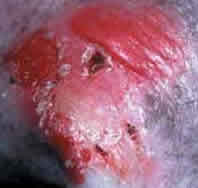 Picture of cat skin vesicle
Wheal: A wheal is a raised area that tends to heal by itself in minutes or hours. It is an area with increased redness or has a pale color when compared to surrounding areas. It is also referred to as a cat hive with symptoms such as severe itching. Common causes include certain foods or drugs, infection, insect bites or allergy.
 Picture of cat skin wheal (hives, insect bites)
Nodule: A nodule is a larger elevated bump on the skin. Causes include an abnormal cell growth (neoplasm that is benign or malignant). It can also be caused by bacterial or fungal infection.
 Picture of cat skin nodule
Tumor: A tumor is a large tissue mass. It is caused by abnormal cell growth (neoplasm that is benign or malignant) or due to some type of inflammation.
 Picture of cat tumor
Feline Miliary Dermatitis: Collection of small bumps in a red areas of skin. There are multiple causes.
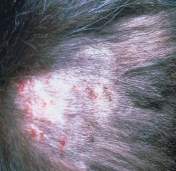 Picture of Cat Miliary Dermatitis
Types of Cat Skin Problems
If you can't match one of the picture, try continuing your investigation by clicking the links below that best match the cat skin symptoms, or what you believe is causing the cat skin problems.
Cat atopic dermatitis in particular is the second most common cause of feline skin conditions after flea allergy (see below). Symptoms are similar to flea allergy so if you cat has been on a flea preventative, then atopy should be the next area to investigate. The condition is usually treated with a prescription steroid such as the medication prednisolone. If any skin rubbing resulted in infection, then antibiotics will be prescribed as well.
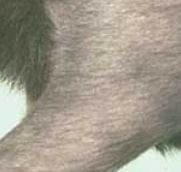
Cat Skin Problems can be caused by Atopy, which are inhaled seasonal allergies can cause hair loss on body (rear leg) as shown above
Source: Dermatology for the Small Animal Practitioner (Mueller)
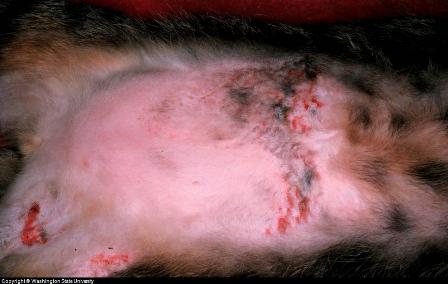
Food allergy dermatitis in a cat
From the collection of Dr. Barbara Stein, Washington State University
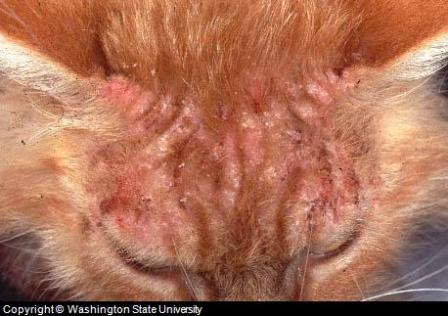
Cat Skin Food Allergy Dermatitis
Source: Washington State University, Dr. Candace Sousa, DABVP, DACVD
Senior Veterinary Specialist, Veterinary Specialist Team
Pfizer Animal Health
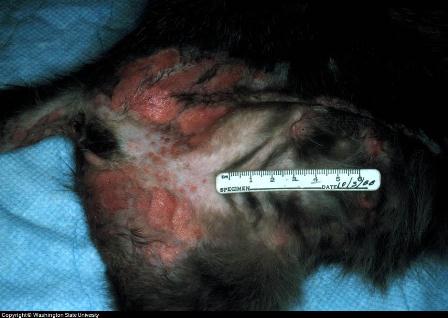
Cat Skin Problems or Plaques caused by Flea Allergy
Source: Washington State University
Miliary dermatitis refers to cat skin problems where scabbing lesions form in areas under the chin and neck.

Cat Miliary Dermatitis
Even a few cat fleas can result in skin problems on the back half of the body, or all over the body. Problems are also often seen above the tail. It can be difficult to find the fleas since cat fur is thick and fleas tend to hide near the skin. Even if your cat stays indoors, fleas can be brought into the house on your shoes, or the shoes of your visitors. They can also be spread by other pets. This is why all cats and pets in a home need to be on flea preventatives such as Frontline Plus® and Advantage®. Avoid off-brand products such as Pet -Armor®. Even though these have the same active ingredient as Frontline, the concentrations could be delivered in a different medium and therefore possibly be less effective (ask your veterinarian for the best product to use for your cat).
Treatment includes killing all fleas, and then using a flea preventative. During recovery, improve hair condition with a homeopathic (see bottom of page) and Omega Fish Oil Supplements.
- Ringworm:
(also called dermatophytosis) Ringworm in cats
is less common than cat flea allergy or atopic dermatitis. This fungus
occurs in cats with inadequate immune systems, which is a particular
problem in kittens whose immune systems haven't had time to develop.
Cat ringworm symptoms include hair loss and crusting on the paws and
face. Some cats can be
carriers of the disease without showing any symptoms, which could
explain why one cat in a two cat household has the disorder.
- Cat
Skin Fungus
Symptoms of Feline Skin Disorders
Symptoms of feline skin problems include:
- Dry, flaky cat skin
- Red, irritated looking skin called skin lesions
- Loss of hair (called cat alopecia, or the result of atopy see feline skin allergies above)
- A dry, dull-looking coat
- Lumps or bumps on or under the skin
- Red patches on the skin
- Round raw lesions on the head, hips and chest called cat hot spots
- Scaly patches or scabs on the skin
- Your cat may scratch or lick her skin excessively (called pruritis)
Diagnosis
Your vet will examine your cat’s skin carefully as part of a complete examination. In order to properly diagnose any cats skin problems in the following order:
- Physical Examination: Some types of cat skin disease such as fleas are immediately identifiable by your vet. such as fleas.
- Skin Cytology Tests: The next most likely cause is a cat skin infection caused by bacteria. Cytology tests are used to examine skin cells in order to confirm this specific diagnosis.
- Fungal Culture Test: This test is used to detect fungal infections such as cat ringworm. Results take 2 to 3 weeks, so the test is often given at the first office visit just in case. A special lamp called a Woods Lamp is also used as an in-office diagnostic test for certain types of cat fungal skin infections.
If the fungal culture is negative, then most vets will conduct additional tests such as: - Skin biopsy: These tests look for problems such as cat skin cancer. In this test, a needle is used to remove cells from a lump to be examined by a pathologist. This can determine if a lump is cancerous or if it is just a cyst or wart.
- Food Trial: Food allergy is a common cause of allergy in cats. If this cause is suspected, then the vet will recommend a hypoallergenic diet .
- Blood and Serum tests: These tests can be used to check for infections, certain nutrient deficiencies and allergens (serum tests). Intradermal tests (skin surface tests) can also be used to test for certain allergens that are causing atopic dermatitis (skin inflammation), after other possible causes are eliminated.
Identifying Cat Skin Problems by Location on the Body
The location of the cat skin disorder can also indicate the type or problem your cat might have. For example feline skin problems on the ear can indicate mites or food allergy, a facial problem could be mange and near the tail is most likely a problem with fleas. Hair loss on the back half of the body are often due to food allergy or atopy (hypersensitivity to allergens in the air such as pollen, dust mites or mold spores).
Certain breeds have a higher incidence of cat skin problems. For example:
- Abyssinian cats: earwax and cat ear canal infection (otitis externa), excessive grooming (feline psychogenic alopecia)
- Persian cats: cat walking dandruff (caused by mites, cheyletieliosis, cheyletiella dermatitis), Ringworm (dermatophytosis), superficial dermatitis that occurs in skin folds due to moisture that leads to skin infection, feline seborrhea (skin flaking)
- Siamese cats: food allergy, hair loss (feline hypotrichosis), white cat hair around eyes (periocular leukotrichia), cat white skin patches (cat vitiligo)
There are also problems that are unique to kitten skin.
Treatment
The treatment of the diseases and conditions associated with feline skin problems depends on the exact disease or condition.
Home Cat Skin Treatment and RemediesIf the cat skin condition is mild, meaning there is mild skin itch or skin flaking, then you can try home treatment. First, look for an early stage cat flea problem. Even if you don't see fleas in your home or on your cat, don't immediately eliminate this as a possible cause since fleas are great at hiding. Also, contrary to popular belief, fleas are one of those cat skin problems that can occur at any time of the year. To check for cat fleas, use a flea comb and comb through your cat's coat, with special focus on the area just above the tail and also be sure to carefully examine the back part of the thighs.
If you suspect cat fleas, you'll want to kill the fleas that are on your cat using a product such as Adams Plus, followed by the use of a flea preventative. If this is the cause be sure to also clean your cat's environment to remove any hiding fleas. Check with your Vet for a specific product recommendation as well.
Therapeutic Shampoo
Next, if you rule out fleas as the cause of the cat skin problems, you can try bathing your cat in a colloidal oatmeal shampoo or use over-the-counter sprays or waterless bath foam (if your cat hates baths) to see if you can bring some relief. These are not cures, but can help with symptoms. Avoid using medicated shampoos at first, as these can often irritate the skin. If the natural shampoos don't help, then a medicated cat shampoo is worth a try (see below). The key to shampoo therapy is contact with the skin, which isn't always easy with a cat that hates the water.
Instructions for Applying Shampoo
The ideal length of time for a shampoo to stay in contact with the skin is 10 minutes. If you cat allows it, massage into the skin, and then rinse the shampoo off your cat for 5 to 10 minutes.
If the non-medicated approach does not help, try these shampoos depending on the symptoms and suspected cause of the condition.
Cat
Skin Problems and Suggested Cat Shampoos
|
||
|---|---|---|
|
Cat Skin Disease and Symptoms |
Product |
Typical Frequency of Shampooing |
|
Bacterial cat skin Infection, Fungal infection. |
Duoxo with Chlorheidine |
Every 1 to 14 days, |
|
Mild skin flaking (seborrhea sicca, seborrhea dermatitis), cat dandruff |
Veterinary Formula Shampoo |
2x to 3x per week until improvement is seen, then reduce frequency |
|
Dry Cat Skin and itchy cat skin |
Paul Mitchell Cat Shampoo with colloidal oatmeal |
Every 3 to 14 days as needed |
If you notice the cat skin condition worsening, despite your home treatment, see a Vet. Always see a Vet if you see hair loss, red skin areas, pus or oozing areas on the skin.
Also, if your cat has scratched herself too much, antibiotics may be necessary, as a secondary bacterial infection may have set in. Treatment may involve oral or topical medications.
Treatment may also involve surgical removal of any lumps or bumps from your cat’s skin. This is usually only done if the growth is cancerous or if it seems to be bothering your pet. If it is benign and is not causing your cat discomfort, it can be left alone.
There are several over the counter homeopathic products that could help to improve overall skin and coat condition such as Skin and Coat Tonic.
References
Dermatologic Examination
R.S. Mueller
Department of Clinical Sciences College of Veterinary Medicine and Biomedical Sciences
Colorado State University, Fort Collins, CO, USA
Carter, G.R., Wise, D.J., and Flores, E.F. (Eds)A Concise Review of Veterinary Virology
Cornell University College of Veterinary Medicine - The challenge of Cat Skin Disorders
Ask Our Vet a Question about a Cat Skin Problem
Do you have a question about a cat skin problem? Share it! We'll pick one question to answer each week for free.
Please let us know about the age of the cat, breed, when any cat skin symptoms began, have they changed over time, if your cat is indoor or outdoor, the presence of other pets, changes in your cats routine, bathing frequency, or anything else that will help us understand your cat's medical history, any tests and results.
If possible, please include a picture. Seeing the skin problem can help us improve suggestions made. Please include information such as breed, age, sex, history, changes in behavior, products used etc.
We will try and respond as quickly as possible. If you have an urgent question we suggest using this online veterinary cat answer service that is staffed by vets and available 24 hours a day. You only pay a small fee for answers you accept.
What Other Visitors Have Asked and Vet Suggestions
Click below to see contributions from other visitors to this page...

Small Growth on Back of Cats Neck 
How to Cure a Small Growth on a Cat Neck
I just noticed last week that my 14 year old spayed cat has a small bubble like growth about the size of …

Treating Cat Skin Bumps
Dear Cat Health Guide,
The lovely cat where I work has an obvious skin problem to her back. There are bumps all over a large patch of her back which …
The Worst Cat Facial Skin Wounds I’ve Ever Seen
We feed and take care of some stray cats outside. This one male cat came around with what looked like a HUGE bite on the entire side of his face. A HUGE …

Hair Loss and Crusty Scabby Skin
Reader Question: Why Is My Cat Losing Hair?
My cat has been suffering from hair loss for about six months now. He gets scabs around his neck and …

Sarcoma At Site Of Injection
Reader Question: How Do I Know When To Put My Cat Down?
Hello,
My name is Amy and my beautiful cat's name is Rusty. I've had Rusty since I was …

Blood Filled Cyst in Cat Ear
My cat has developed some skin bumps or cysts that are blood filled. The look like mites however they are not, they are more like hemorrhages.
I have …
Cat Chin Acne
Hi, my cat Fred has developed what I describe as cat acne under his chin. It looks very much like F M dermatitis, but I’m not 100%. It doesn’t seem to …
Cat Losing Hair Causes and Treatment
Reader Question: Why is my cat developing bald spots?
Hello,
Our 18month old ginger cat has started developing bald spots around his back end, …
Cat Skin Infection Care and Treatment
My female cat was attacked by street dogs several months ago and has since had partial paralysis of her hind limbs, i.e. one of the legs seems to have …

Cat Skin Tumor on Stomach
My mother has two young male cats that live outside. She hasn't had the money to fix them or have any kind of shots done, so they've just lived on her …
Growing Mole Below Cat Eye Duct
My old persian has a black mole that has been slowly growing larger, below her inner eye duct, slowly in the past 5-6 years.
She has had an infection …

Cat Itchy Skin with White Flakes
My 25 pound 10 year old female cat Abby has flaky skin with tiny white surface dust on her back spinal area. She exhibits no illness except long oral cleaning …
Long Hair Cat Skin Problems and Vet Solutions
My cat has lumps and dried skin all over his body. My family says he is about ready to die but i don't really think so, but anyways I have had him since …
Cat Scabs Causes, Treatment and Vet Advice
We have a 13 year old short hair cat with a large (quarter sized) red, slightly oozy lesion on his neck. He also has various small scabs in on his head/neck …
Cat Skin Bumps
My female cat Pepper is 3 years old and over the past 3-4 months (this past summer) I have noticed several bumps under her fur. When I first touched them, …

Care for Cat Skin Tumor
or Cat Skin Cyst
Question: My Persian cat has a huge white bubble on the side of his face. I only noticed it about a week ago but my mother said its been there a while. …

Cats With Black Hair and Skin Problems
I have owned numerous cats and dogs with various hair types and colors. It seems common that my short, black-haired animals all suffer from skin irritation …
Cat Matted Hair Tips
I have an elderly cat (14 years old) who is overweight and is having difficulty grooming herself. She is a semi-long hair cat with some kind of weird condition …
Cat Ear, Mouth and Eyelid Skin Problems
Our cat was a feral kitten that now is an indoor/outdoor cat of just over a year old. We live in NY and over the past few weeks she has had small, black, …
Cat Dog Bite
Two weeks ago a dog bit my cat. I took my cat to the vet for an infected dog bite on my cat's stomach and near the anus. He treated my cat, gave antibotic, …

Cat Skin Diseases of Unknown Cause Diagnosis and Treatment
Cat Skin Disorder Reader Question: It started as a very small bump under the surface of the lower eyelid. It eventually progressed into hair loss around …

Skin Allergies in Cats Skin Sympoms and Treatment
Cat Skin Problem Reader Question:
I have a male castrated cat. He is 2 1/2 years old now and the skin problem started last July 2009. It started as …
Cat Dry Itchy Red Skin Problems
I have spoken to you before about this problem with my female cat - and your answer I found to be very helpful. But one of the products that you mentioned …

Growth on Cats Nose 
We have a healthy 8 yr old female cat of mixed breed. She is primarily an outdoor cat. We live on land with wooded acreage and she is always on the prowl …

Sore Spots Under Matts Not rated yet
Picachoo, a rescue cat, went to the vet with severe matts under the matts was sore spots oozing green. Vet shaved her and gave Covenia for infection, …
Tomcat with skin issues Not rated yet
I was wondering if you might be able to help me figure out what is wrong with my cat. He is a 5 year old tomcat, I'm not certain on the breed but he is …
Heartbroken Cat Lover... Need help with a stray cat I found Not rated yet
A stray cat came wandering into my yard last night. He looked cold, skinny and hungry so I let him in to eat and warm-up. When me and my partner were …
Bump on Cats Stomach Not rated yet
Reader Question: Cat Missing Hair on Stomach
My cat has two round circles of missing hair. Inside the circles are a little brown spot, which looks …
Strange White Skin Lumps On Cat Not rated yet
Reader Question:> Are cat skin lumps a cause for concern?
My one year old black and white Tom cat has 4 very small 'lumps' on his head which appeared …
Recurring Skin Infection in Cat Not rated yet
Reader Question (followed by some suggestions from our Veterinarian):
Hello, I have a 6 year old male, neutered cat. I adopted him when he was 6 …
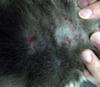
Itchy area around Cat Eyes and Under Chin Not rated yet
Reader Question: Are allergies to blame for a cat that is rubbing the eyes or itch?
My cat rubs and scratches the corners of her eyes and the skin …
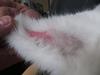
Cat Skin Issue Under Front Leg Not rated yet
Reader Question: Cause of Lesion on Cat Leg
My cat, Mr. Beeg is a Domestic short hair, 12-13 yrs, male, neutered, We use Diamond brand maintenance …
Dog With Dull Coat Not rated yet
My 17-year-old female was getting a dull coat. When I groomed her, I discovered lumpy mats that were difficult to get out, even though she is a short …

Treating A Scaly Patch of Cat Skin Not rated yet
Reader Question: How To Treat Kitten With Scaly Patch of Skin
A couple months ago, my boyfriend and I adopted a 10-week-old Scottish Fold kitten from …
Lump Under Cat Skin Not rated yet
Reader Question: My Cat Has A Mass In Her Body That Blocks The Flow of Bodily Fluids, How Can I Treat This?
I went to the vet for treatment of a lump …
Lumps Under Cat Skin Not rated yet
I was petting my 6 month old female cat's stomach and felt several large, movable lumps beneath her skin. The lumps are mostly around her teats.
She …
Healing Damaged Cat Skin Not rated yet
Reader Question: Healing Cat Skin Damaged From Fleas
I picked up a kitten off the street, couldn't resist, not very old, but cute and able to be away …
Cat Lumps on Nose Not rated yet
Hello,
My cat friend is a 1 year old un-fixed male cat. Recently he has started to act strange. Just very unlike him self, and sleeping a lot.
I …
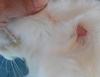
My Kitty Sasha Has Back Sores Not rated yet
Reader Question on Back Sores Followed By Suggestion From Our Vet
I rescued my kitty Sasha when she was only 2-1/2 weeks old and she has given me 7 …

Cat Skin Bump with Vomiting and Scooting Not rated yet
Within the last month, I had a fence put up and have allowed my indoor cats to go outside. They do not or have not climbed the fence. I just noticed …
Cat Losing Hair After Groomer Visit Not rated yet
We recently took our 9 year old Persian to a cat groomer where he received a bath and a lion cut. When we picked him up afterwards, I noticed that his …
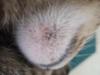
Cat Chin Acne Not rated yet
These patches (see photo) are located on several places on our cat's chin. Do you have any possible diagnosis or remedies? It hasn't seemed to bother him …

Hairless Patch on Cat Face Not rated yet
On the closed cat eye in the picture, a small flat not scabby patch has formed. This is an indoor and outdoor cat, Siamese, behavior normal, no scratching …
Outdoor Cat Skin Problem by Ears and Eyes Not rated yet
About a week ago, I noticed our cats fur had been matted down. I thought he was wet, but when I looked closer, I noticed he had blood and skin torn away …

Kitten Skin Wound Care Not rated yet
Hello,
Our large dog saw that the momma kitten was trying to move the babies and she picked up the 2 week old male kitten. She then took the kitten …
Cat Waxy Coat Not rated yet
My cat's fur is very dry but when you stroke him some brown waxy stuff comes off. He also has eczema. He has been tested for mites, has no fleas and is …
Cat Flaky Skin Not rated yet
Hello, I have 3 cats and the female Maisie-Mae, who is a short haired black, neutered 4 year old has very flaky fur! I comb her every day as her fur is …
Could this be feline psoriasis? Not rated yet
My cat had recurring bouts with hair loss, scabs, and scratching. None of my other animals have been effected. It doesn't seem to be cat mange. What do …
Cat Coat and Skin Problems Not rated yet
I have a female cat who is always licking at her tummy/chest. She seems to have itchy skin - not fleas. It could be an allergic reaction to being bitten …