
Key Takeaways
Flea Allergy Dermatitis (FAD): This is the most common skin problem in cats caused by an allergic reaction to flea bites, leading to itching, hair loss, and dry skin.
- Fleas in Indoor Environments: Fleas can be brought into homes by people or other pets, making even indoor cats susceptible.
- Health Risks: Beyond skin problems, fleas can cause anemia in cats due to blood loss, and transmit diseases like tapeworm.
- Seasonal Occurrence: Flea infestations are more common in warmer months and less likely in extreme cold. Young cats under one year are less prone to fleas.
- Symptoms of Flea Infestation: Symptoms include itching, red bumps, hair loss, and sometimes more severe skin infections due to excessive scratching.
- Diagnosis and Detection: Fleas and flea excrement (flea dirt) can be spotted visually or with a flea comb. A water test can confirm flea dirt.
- Treatment Approaches: Effective flea control involves treating both the cat and its environment. This includes oral medication, spot-on treatments, antihistamines for itching, and environmental cleaning.
- Products and Precautions: Use only cat-specific flea products. Some ingredients in dog products, like permethrin, are harmful to cats.
- Variety of Treatment Options: These range from shampoos, powders, sprays, and topical creams to oral medications. Herbal remedies are also available for more natural approaches.
- Environmental Control: Treating the home environment is crucial to prevent re-infestation. This may include carpet treatments, sprays, foggers, and professional extermination if necessary.
- Human Risk: While cat fleas prefer cats, they can bite humans, especially in the absence of their preferred host, leading to itchy red areas on the lower body.
- Risk of Disease Transmission to Humans: There's a potential risk of diseases being transmitted to humans, particularly to individuals with compromised immune systems.
Cause
Allergies from cat fleas are caused when a flea bites your cat's skin. The reaction itself is due to sensitivity to the saliva in the flea's mouth. A typical flea allergic reaction will have your cat itching the moment they come in contact with the fleas. Itch from flea allergies could even continue after all the fleas have been killed.
Recent studies have shown that flea saliva contains around 15 different allergens that can cause reactions in sensitive cats.
An adult flea is a small dark brown insect that can be seen with the naked eye. Flea eggs look like specks of salt and pepper.
Flea infestations usually occur in warmer months. They cannot survive extreme cold.
Cats younger then 1 year of age rarely suffer from cat fleas.
Potential Health Problems
Feline fleas consume blood the minute they attach themselves to a host (your cat). They can cause iron deficiency and a condition called anemia which is a lower than normal number of red blood cells.
Fleas can also transmit disease into the host such as tapeworm, which is an intestinal disease caused by the worm as it grows.
The most common symptom of flea problems is the skin condition known as flea allergy dermatitis (FAD) which usually results in a condition called feline miliary dermatitis and pruritis (severe itch). Your cat's reaction to the need to itch can cause problems such as scratches. The licking and scratching may cause your cats hair to fall out resulting in a strip without hair, a condition called alopecia and a stripe without hair.
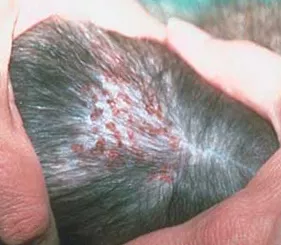 Cat Hair Loss Due to Fleas (Miliary Dermatitis)
Symptoms
Common symptoms of cat fleas include itching, red pimples or bumps on your cat's behind (rump), under the legs, base of the tail, groin or belly. The skin may appear red and inflamed. When your cat goes to itch this area, their hair can fall out and their skin becomes dry. If you draw an imaginary line around the center of your cat, and only see symptoms in the rear half, it is probably fleas.
A flea allergy tends to be seasonal and will cause worse symptoms during summer and fall when fleas are most active and when the warm humid environment exists that they like.
Fleas will live on your cat for up to 115 days and only 1 to 2 days if not on a host. A female flea can give off 2000 eggs which can incubate in carpet and under furniture in the house. The eggs will then hatch in days or months depending on the conditions in the house (ideal temperature is 65 degrees). The fleas then seek a host such as a pet. If they don't find one they will die in 1 to 2 weeks.
If the condition continues, the skin can become crusty and infected causing crusty lesions.
Cat Flea Allergy Diagnosis
If your cat is suffering from fleas in the late summer, then most veterinarians will assume that the cause is fleas. They will look for the presence of the fleas themselves and flea excrement which is small dark pellets called flea dirt. One way to know for sure is to take the pellets and put it in water. If from fleas it should dissolve into a reddish color.
Is is possible that your cat through grooming removed all the fleas, making diagnosis more difficult. You can also try using what is known as a flea comb to check your cat's coat.
The best way to check for fleas is to place your cat on a piece of white paper. Brush the coat and if you see white and black grains of what looks like sand. The droplets are actually lea eggs and feces. There is also a skin test that your veterinarian can use to test for flea allergy and fleas.Treatment of Flea Allergy
Most cats are cured when the fleas are eliminated from their body, hair and where they live. All pets that live with the cat should be checked as well. Your vet will treat fleas with oral medication or with a spot-on treatment. You can also use an antihistamine to help with the itching, or your vet may prescribe corticosteroids for that purpose. Antibiotics may be prescribed if secondary infections have set in due to excessive scratching. You can either try natural approaches to flea removal or prescription medications from your veterinarian.
There is also a skin test your veterinarian can do to see if your cat tests positive for fleas. There are other conditions that result in dermatitis that is similar to the type caused by fleas. These cat skin problems include parasites such as mites (mange), skin allergy (atopy), bacteria and for causes that cannot be identified.
Eliminating fleas on your cat just removes only part of the flea problem. Flea eggs fall from your cat and adult fleas can easily jump from your cat into your environment. If you only treat your cat, she will quickly be re-infested with fleas that are still living in your home. You must kill the fleas on your cat AND in your home.
Treatment Program for Cat Fleas
There are several products that can help to prevent cat fleas. Do not use products made for dogs on cats since they could cause harm.
The goal of flea treatment is to remove the fleas from your cat and your cat's environment. ONLY PURCHASE PRODUCTS THAT ARE CLEARLY LABELED FOR CATS. For example the ingredient permethrin, which is used in some dog products can be very harmful to cats.
Flea products are applied directly to the skin of your cat. It takes 1/2 to 1 and 1/2 days until the flea product spreads and kills all fleas.
The use of only one product should be fine since most products today can both kill adult fleas and fleas that are just developing. In the past this wasn't the case.
Comb your cat every other day with a Flea Comb Kill the fleas on the comb by dipping the comb in alcohol or detergent.
See our complete list of cat care flea skin and outdoor products.
If you feel the need to use multiple products to cope with a severe infestation, do so only with the advice of a veterinarian or health professional since not all products are safe to use together.
There is also one product that is given orally that works faster (several hours) than the topical types of treatments. This product contains nitenpyram. Flea products called spot-on use the ingredients fipronil, imidacloprid, or selamectin and take 12-42 hours.
If your cat continues to scratch you might want to consider a topical product made to soothe the skin.
Treatment Options
Today, liquid products that apply directly to the skin or oral products should be enough to protect against feline fleas. Products such as Frontline Plus, Revolution and Advantage and Program should work well. Consult your veterinarian to determine if you need to go beyond these products to other methods of treatment and prevention.
- Collars: Popular and widely used, yet aren't always effective. Collars are only a partial solution and should be supplemented with other approaches.
- Shampoos: Effective option for mild cases and when the areas where the cat lives no longer has fleas. Shampoos with Pyrethin are best for younger cats.
- Powders and dusts: Best used with other products such as shampoos. They are used 2 times per week and must be worked into your cat's coat.
- Sprays and foams: Look for water based sprays (vs. alcohol based sprays which can irritate skin). Use sprays in between shampoo treatments to kill any fleas that may have jumped on your cat from the environment that you missed. Spray treatments last for up to 14 days.
- Topical hydrocortisone creams: are used for dermatitis, but may cause side-effects when used regularly. Consider a herbal cream instead.
- Herbal Creams: creams will effectively treat, soothe and prevent flea bite dermatitis without the side effects of prescription creams for this condition.
- Insecticide dips: The best choice for thoroughly killing fleas on your cat. Most dips need to be applied every 7 to 10 days. Follow manufacturers directions and avoid using on kittens without the advice of a veterinarian.
- Liquid Medication: Program (lufenuron suspension) given once a month, mixed with food. Cats must be at least 6 weeks old.
You must rid your house of fleas or else your cat can suffer a re-infestation. This may include use of a professional exterminator, carpet shampoos sprays and foggers. Different products are used for indoor and outdoor infestations.
If you are cleaning carpet fleas the best product to use is the borax based Fleabusters Rx For Fleas Plus. Borax is highly effective at killing fleas.
Read more on cat flea care treatment options.
Feline Flea Treatment and Prevention Products
Feline Flea Treatment and Prevention Products |
||
|---|---|---|
|
Brand |
Ingredients |
Description |
|
Frontline, Frontline Plus (topical liquids applied to skin), Frontline Spray |
Fipronil |
Slow release and resists water. Protects against ticks and adult fleas. Choose Frontline Plus since is protects against adult fleas and has methoprene which is what is called a Insect Growth Regulator to protect against developing fleas and larvae. kills fleas within 24 to 48 hours. Can last as long as 90 days. Not absorbed by bloodstream/non-toxic. |
Advantage II - used 1x month by applying liquid to cat's skin between shoulders |
Imidacloprin and Pyriproxyfen |
Works well against fleas. Does not target ticks. Each dose works for 30 days. Kills any flea that comes in contact with skin.Almost all are killed within 12 hours of use. Not absorbed into cats bloodstream/non-toxic. Advantage II contains Imidacloprin and Pyriproxyfen to kills adult fleas, flea larvae and flea eggs to break the flea life cycle and prevent further infestations. |
|
Capstar (oral medication) |
Nitenpyram |
Starts killing fleas in 30 minutes after your cat takes the medications. Safe for nursing cats. Only works for 24 hours and can be given often. Follow use with a product like Frontline Plus under advice of a veterinarian. |
Can Cat Fleas Bite Humans?
Cat fleas prefer cats as their host. However, to live, adult fleas need to drink in either pet or human blood. If the flea cannot find a pet as host, they will attach to a human.
Signs of human flea bites are usually on the lower parts of the body where the flea attempted to bite after leaping up from the ground. This includes small, red itchy areas around the feet and ankles.
It is possible that fleas transmit diseases to humans that are troublesome for individuals whose immune system is not working properly. Also if the fleas infected your cat, and your cat scratches you, it is possible to get a disease called Bartonella which is more commonly called cat scratch disease. This disease is also only a problem in individuals with a compromised immune system.
References
Greek, Jean, DVM, ACIDM
New Hope Animal Hospital
Atopic Disease and Allergy
Beale, Karin M. DVM
Gulf Coast Veterinary Specialists
Atopic Dermatitis: Clinical Signs and Diagnosis
Ihrke, VMD
Professor of Dermatology
School of Veterinary Meicinea
University of California
Flea Allergy Dermatitis
Cat Owners Home Veterinary Handbook
Delbert G. Carlson DVM and James M. Giffin, MD
The Merck/Merial Manual for Pet Health
Update on the Diagnosis and Treatment of Fleas and Mites
Prof. Dr. Ralf S. Mueller, DipACVD, FACVSc, DipECVD, FAAAAI
Medizinische Kleintierklinik, Ludwig-Maximilian-University Munich, Germany