Cat Ringworm Symptoms and Treatment
"The fungal infection cat ringworm can be contracted at any age and is more pronounced in younger cats. Cats with ringworm can either naturally fight off the fungus, the fungus can continue to live on the cat with no symptoms, or the skin can become inflamed. Infected areas may look like the hair has been shaved or broken in a circular area with skin looking red and crusty. Other symptoms can include changes in skin or hair color, excessive scratching and itch, and infection in the nail beds or claws. The fungus feeds on keratin, a natural substance found in the nails and hair. The condition is one of the most common feline skin conditions. Feline ringworm treatment includes the use of topical skin ointments in affected areas and the possible use of an oral medication. If a cat has several affected areas, a dip might be recommended as well. Treatment could take weeks or months. if a cat is not treated, the fungus can spread to other animals. While some cats may be able to fight off the infection without treatment, this could take as long as a year."
Cat Ringworm is not a worm, but a fungal infection
technically called dermatophytosis. It’s called ringworm due to its
appearance - in humans, it appears as a crusty red circle with a pale
center. That’s right, people can get ringworm, too. You can get it from
your cat, or she can get it from you. If you have symptoms of ringworm,
you should see a doctor for treatment. (Don’t worry, it’s easy to
treat).
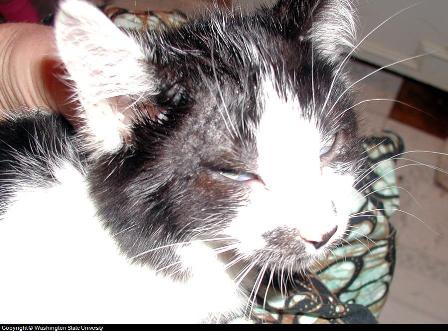
Picture Kitten Ringworm
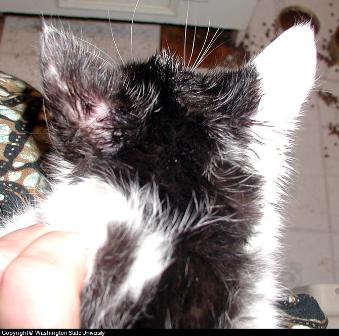
Picture Kitten Ringworm
While any cat can get ringworm, some are more susceptible than others. Young kittens, long haired cats, cats in crowded conditions such as shelters, and those with other health problems are more likely to contract the disease. Some cats may be carriers without having any symptoms. They can still pass the disease on to others.
The fungus grows down from the base of a growing
hair shaft (cuticle).
Ringworm Symptoms in Cats
In cats, ringworm
symptoms appear a bit differently than in humans. It
generally appears as dry, red or gray scaly round patches with embossed
edges. Your cat may appear to have dandruff. There may be some hair
loss in the area (alopecia) such as if the hair in the area has been
shaved. It’s generally not too itchy, but your cat may scratch or lick
at the area.
The condition can appear on any part of your cat's body but is usually seen on the front paws, tail, head and ears.
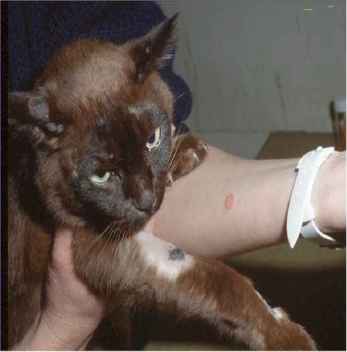
Picture of Ringworm in
Cats
Diagnosing Cat Ringworm
Feline
ringworm can resemble other skin problems, so
your vet may need to do some tests in order to make a diagnosis.
The first thing your vet may do is examine your
cat’s skin under a Woods light. Ringworm will generally fluoresce under
the light. However, some species of ringworm do not fluoresce, and some
other types of infections may fluoresce, so other tests may be needed
in order to confirm the diagnosis.
Your vet can examine some hairs from your cat
under a microscope for ringworm spores. However, spores can be very
difficult to see, for if they are not observed, this does not mean your
cat does not have ringworm.
A fungal culture will identify ringworm and other
fungal infections. The disadvantage to this method of diagnosis if that
it take about ten days. However, if the above methods don’t work, it
may be necessary.
Ringworm Treatment for Cats
Ringworm can be difficult to treat and should
involve a consultation with your veterinarian.
Ringworm treatment for cats is generally treated with a combination of oral and topical medications. Preference is for oral medications and the use of a lime sulfur dip such as Naturasil for Ringworm. Topical ointments are often not as effective since your cat will be tempted to lick it off.
The oral cat ringworm medication of choice is
Itraconazole. Other options include Ketaconazole and Griseofulvin.
Griseofulvin is usually not used since it is associated with side
effects in some cats.
You can also try a natural
skin cleanser that is safe for cats such as
Clenzor.
You’ll also need to treat the environment, because otherwise your cat will just become re infected and the problem could spread to you. First thoroughly vacuum all areas which will pick up infected hairs and skin flakes. You can also mop the surfaces of your home with a product that uses disposable pads such as a Swiffer. Do not touch the pads after cleaning.
To disinfect surfaces in the home, purchase a
product that contains Benzalkonium Sulfate such as Benzarid.
Other options include chlorine bleach (diluted 1 part bleach to 10
parts water), or a strong detergent. Note that products which contain
chlorheidine or povidone iodine are not as effective as other
approaches.
References Cat Ringworm:
Ringworm Infection in Dogs and Cats
R.A. Cervantes Olivares
Departmento de Microbiologia and Inmunologia
Laboratorio de Micologia, Facultad de Medicina Veterinaria y Zootecnia,
Universidad Nacional Autonoma de Mexico, Mexico DF, Mexico
Cornell School of Veterinary Medicine, Feline
Health Center
Washington State University College of Veterinary Medicine
Have A Question about Ringworm in Cats?
Do you have a question for our veterinarian about a cat ringworm problem? Share it and our veterinarian will answer it for free!
If possible, please include a picture. Seeing the skin problem can help us improve suggestions made. Please include information such as breed, age, sex, history, changes in behavior, products used etc.
We will try and respond as quickly as possible. If you have an urgent question we suggest using this online veterinary cat answer service that is staffed by vets and available 24 hours a day.
What Other Visitors Have Asked and Vet Responses
Click below to see contributions from other visitors to this page...
Ringworm in Cat 
I adopted a one year old cat that is either a cross or purebred red colorpoint DSH (often called flame point Siamese.) I adopted him from our local humane …

Are These Cat Ringworm Symptoms? Not rated yet
Reader Question: Does My Cat Have Ringworm?
Two weeks ago, I noticed some red bumps above my cat's eye, after a while they turned into a scab and …
Ring-Ex for Cats Not rated yet
Thank you for your informative article about feline ringworm.
I noticed your recommendation of Ring-ex. This product contains tea-tree oil (melaleuca …
