Probably the best tagline in the world
- Home
- Allergy
- Behavior & Training
-
Diseases and Conditions
Blood Disorders and Bleeding
Bone, Joint & Muscle
Brain, Spinal Cord & Nerve
Cancer
Dental
Digestive System
Ears
Endocrine
Eye Care
Heart Disease
Infectious Disease
Metabolic
Parasites
Poisoning
Reproductive
Respiratory
Skin and Coat
Urinary
- General Health
- About

Kitten Skin Wound Care
by Kacy
(Texas)
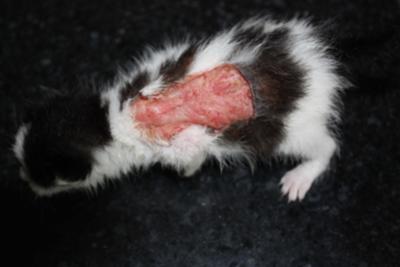

Picture Kitten Skin Wound
Hello,
Our large dog saw that the momma kitten was trying to move the babies and she picked up the 2 week old male kitten. She then took the kitten to the back yard and was really playing with it when I noticed the kitten was out. I rushed and grabbed him, took him inside, cleaned him off with water and put hydrogen peroxide on it (which, I read now was not a good idea). I then put neosporine as well.
The kitten had multiple little tiny wounds and 2 larger ones. The small ones healed back up quickly but the larger ones did not. The mother cat started cleaning the kitten and overnight, had cleaned the hide right off the kitten. What can I do to help heal the kitten? It is very difficult to see him like this.
Editor Suggestion Kitten Skin Wound
Dear Kacy,
Sorry to hear about the kitten skin wound problem.
Injuries and kitten skin problems caused by accidents, injuries and by other animals such as a wound from a dog should be carefully assessed, and then treated accordingly.
In this case, the affected area seems to be broad and requires critical care during the healing process. First of all, you should isolate this kitten from other pets, since other animals might keep scratching and cause the wound condition to get worse.
Application of an antiseptic solution is essential in order to clear the wound from any microbial growth. Using hydrogen peroxide is usually safe, but reactions tend to be individual to a particular kitten. It it for this reason that it is
In terms of a kitten skin wound treatment approach, we recommend that first the would should be cleared of any debris, fur, dust or any foreign particle. An antiseptic solution should be used, preferably a spray applied 2 – 3 times a day or as per manufacturer's directions. We recommend using R-7 Antiseptic Spray or a similar product.
After spraying the antiseptic solution, using antibiotics is a good idea. You can continue applying a preparation containing Neosporin, preferably in a powder form combined with other wound drying agents.
It is always better to cover the wound to prevent any exposure to dust and debris. Use a bandage/ antiseptic pad, which should not be rigorously /strictly tightened.
To enhance skin tissue strength, the immune system and to help with the regrowth of fur, we recommend you use some type of natural remedy to enhance recovery. One product formulated for this purpose is Skin and Coat Tonic.
Also, keep the patient isolated and preferably in a hygienic and clean environment, where the chance of microbial growth is lower.
In case, you see some unusual symptoms, such as the development of pus, bleeding or any signs of a worsening of the wound, be sure to consult a nearby veterinarian to dress and treat the condition with help of a systemic treatment plan, since these symptoms represent the start of a generalized illness.
Best wishes to you and your kitten. Please keep us up to date on your kittens condition.
Join in and write your own page! It's easy to do. How? Simply click here to return to Cat Skin.