Symptoms and Treatment of Cat Scabies
"Cat Scabies is also called notoedric mange or feline mange. A mite infestation, particularly in cats and kittens, is caused by specie of mites called “Notoedris Cati”. The disease is characterized by severe pruritus or itching, crusts and alopecia (hair loss). A localized form of lesions can be noticed on the ear, neck & head. This disease can turn into a generalized form eventually, which means that it can spread over your cat’s body. The treatment plan involves aggressive care, isolation from other cats and pets, lime –sulfur dips and a systemic treatment in case of generalized form. This disease can be transmitted to humans & other animals thus it possesses a zoonotic (Diseases Transmitted from animals to humans) importance too."
The specie of mite which infests cats for feline
scabies is called “Notoedris Cati”. The "Notoedris Cati" mite burrows
into the skin, penetrating in to deep skin tissues. Female mites lays
eggs deep in the skin, while the larvae hatched from eggs grows as a
nymph and then molts into an adult. The entire life cycle takes 2 – 3
weeks. Notoedris Cati, can infest humans as well as other
animals.
Signs & Symptoms of Cat Scabies
Feline scabies is characterized by severe pruritus
(severe itching) and irritation. Initially the signs appear
at the ears, neck & head. Head shake and severe
scratching is common. Alopecia or hair loss is seen frequently. The
edges of ear starts with hair loss, and thereafter hair loss continues
to the head then on to the neck.
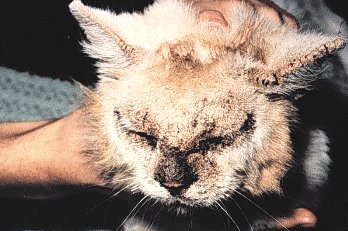
Picture Cat Scabies
There are two clinical forms of feline scabies,
localized & generalized.
Localized cat with scabies
involves itching, irritation, alopecia and crust formation at the ears,
head and neck region. Cats infested with mites becomes restless; shake
their head frequently, continually scratch their head & may
react more aggressively to you or others.
Generalized cat with scabies
usually exists when a cat has scabies and it is left untreated.
Signs of alopecia, irritation and redness may spread to whole
head region. Fever and mild illness may also be noted in rare cases.
Diagnosis of Feline Scabies
The signs and symptoms mentioned above that characterize feline scabies are usually helpful in diagnosing scabies. Skin scrapings are also helpful in confirming a diagnosis. Your veterinarian will make sure the cat scabies isn’t confused with a similar condition called feline demodicosis, which is another form of mange.
Treatment of Cats with Scabies
Treatment of feline scabies involves the use of a lime-sulfur dip at an interval of 10 days. Lime–Sulfur has proved to be most effective way to treat cat scabies. A popular dip that is available over the counter is offered by Naturasil. The advantage of Naturasil is that it can be mixed into your cat's regular shampoo, which minimizes a negative reaction to an unfamiliar dip or shampoo. If you cat will tolerate a different shampoo, then bathing diseased cats with a quality shampoo containing antiseptics along with dipping is effective.
Other
options include a Selamectin injection
administered at an interval of 2 – 3 weeks. Ivermectin injection is
also effective but adverse effects have been reported in kittens.
You
will also have to make sure that are area
where you cat lives is free from mites. We suggest using a
product designed for use in the home such as Benzarid.
Side Effects of Feline Scabies Medications
Sudden death has been reported in kittens administered with Ivermectin. Amitraz is effective, but higher concentrations have adverse allergic effects in cats. Cat scabies may be transmitted to humans & other animals, also cats with severe infestation may react aggressively towards others. Because of this, caution should be used when handling a cat who is undergoing treatment of this condition.
Prevention of Cat Mange
Preventing frequent contact with other cats & especially with affected cats lessens the chances of infestation. Hygienic measures should be taken as a priority and diseased cats should be isolated. An immediate and appropriate treatment plan should be followed as initial signs appear.
References:
The Merck/Merial Manual for Pet Health
J. Brahmas., et al. Veterinary
Parasitology, (Delhi Publishers, India 2004)
Washington State University College of Veterinary Medicine
Share Your Questions and Stories on Treating Scabies and Mange
Help other owners who are treating cats with mange or ask your questions and our Veterinarian will answer for free!
Please provide details such as your cats skin condition, age, breed and other medications. Submit pictures if you can below.
Our Veterinarian will respond as quickly as possible, which is based on the number of questions received.
If you have an urgent non-emergency question we suggest using this online veterinary cat answer service that is staffed by vets and available 24 hours a day.
What Other Visitors Have Asked and Responses from our Veterinarian
Click below to see contributions from other visitors to this page...
Treating Cats for Human Scabies? 
I continue to get reinfected with human scabies after following proper protocol. My doctor suggests that my cats may be a carrier and a source of reinfection. …
Prevent Cat Scabies After Exposure
What can I do to treat my "indoor" (unspayed) cat who escaped last night to mate with a feral Tom we recently observed that has scabies? I washed her well …
How to Treat Cat Scabies Not rated yet
Reader Question: How to treat feral cat scabies?
We have feral cats at our church. A strange cat who was diseased (looked like your pictures of …
Cat Scratching Head and Ears Not rated yet
I am not sure if my cats have mange. I have 9 indoor cats who are scratching their heads and ears. They are also losing hair in that area. i have taken …
Cat Scabies - What do they look like? Not rated yet
Do cat scabies look like little slugs around the neck.?
Answer: It depends upon severity of symptoms. Cat scabies first appears on the ears and periphery …
