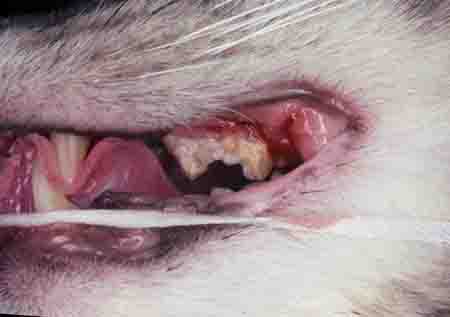
Common problems include plaque and gingivitis formation that can lead to other problems such as lesions. It is estimated that 50% of cats that are 5 years of age or older have some form of dental disease and are experiencing related discomfort.
Over 85% of cats over age 6 have some form of periodontal disease.
In general, cat dental diseases are grouped into four areas:
Overview
Dental care in cats is similar to dental care in humans and is just as
important. Over 70% of cats show some form of dental disease by age 3.
Like humans, cats have baby teeth that are
then replaced by adult
teeth. They have
26 baby teeth, which they begin to lose and replace with adult teeth
from 11 to 30 weeks of age. During this time their mouths may be sore
and they may eat less. Adult cats have 30 teeth (12 incisors, 4
canines, 10 premolars and 4 molars)
There are six incisors on the top jaw and six on the bottom jaw.
These are used to nibble shreds of meat from bones and also for
grooming.
There are two teeth on the top jaw and two on the bottom. These are
the fangs. They are used to hold objects in the cats mouth and to
defend themselves when necessary.
Then there are ten premolars and four molars, which work together to
cut food.
Cat Calculus Deposits on the tooth
Surface. It forms through the calcification of dental plaque. It begins
as a yellow film and if not removed, can cause bacteria to take hold
between the teeth and gums, resulting in infection and other cat dental
problems.
How to Brush and Clean Cat Teeth
Video: on How To Brush Cat Teeth
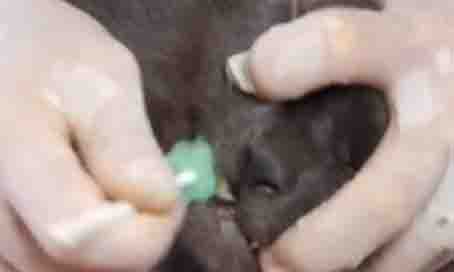
Put the cat on the table
Don't open the mouth, just push the lip back
Buy a small cat toothbrush or you can buy a small spongy type
toothbrush made for humans from a local pharmacy (see picture
below). Instead of a toothbrush a soft cloth can also be used to wipe
off any plaque from the teeth and gums. Rub the teeth and gums with the
cloth.
Toothpaste is not necessary, diluted hydrogen peroxide will work fine (75%
water). Dip the brush in it, and it will act as an anti-bacterial.
Brushing Cat Teeth with a Sponge Type
Brush Purchased At a Local Human
Pharmacy
Cat Dental Symptoms
Like humans, cats can have dental problems, such as tooth decay, losing teeth
and gum disease. It is important to help your pet maintain healthy cat
teeth.
Symptoms of problems with cat teeth include:
Bad breath
Yellow or brown deposits on the teeth at the edges of the gums
Reddened gum edges
Receding gums, revealing exposed tooth roots
Drooling saliva (may be tinged with blood)
Lack of appetite
Difficulty chewing food
Mouth pain (pawing at mouth, rubbing side of mouth along the
ground,
or keeping mouth open all the time)
If your cat shows symptoms of problems with her teeth, she should
see your veterinarian for a dental veterinarian for treatment.
Cat Dental Tartar
Cat Dental Tartar or Calculus
Problems
and Treatment
Periodontal Diseases (Feline Plaque, Tartar, Calculus and
Gingivitis)
Cat periodontal problems are characterized by different stages . Each
stage is described below.
Cat dental problems start with plaque (a bacteria) formation on the
teeth. If left alone the bacteria die and combine with the saliva in
the mouth to form calculus (also called tartar). This tartar then
progresses causing inflamed gums, a condition called gingivitis. This
can cause bleeding gums and swelling.
The tartar also forms below the gum line causing an infection at the
root of the teeth destroying healthy tissue and causing a tooth to
loosen and possibly fall out. Diseases such as gingivitis are
seen in stages:
Early Gingivitis (stage 1): Gingivitis is seen in some younger
cats (age 6 to 8 months, called early gingivitis). To avoid this issue,
owners are advised to regularly brush the teeth.
Established Gingivitis (stage 2): In this case, calculus or
plaque starts to form on the teeth. There an also be swelling on the
gums. Treatment involves cleaning the teeth (requires anesthesia). The
disease is reversible with treatment. A veterinarian will scale
the teeth to remove plaque and calculus.
Early Periodontitis (stage 3): When the feline dental problems
spread deeper into the teeth and gums, the cat is considered to have
advanced periodontal disease. The periodontal disease is not
reversible, so care focuses on stop any spread of the disease.
X-Rays are helpful to identify the size of any problems and if
treatments such as pocket reduction, bone or tooth recontouring are
required.
Established Periodontitis (stage 4): In established periodontitis
deep periodontal pockets have formed (greater than 5 mm). Other
problems include gums that have recessed, or the loss of bone.
Treatment includes the above plus home dental care. It may be necessary
to extract damaged teeth. Care will be taken to save healthy tissue and
teeth.
End-stage Periodontitis (stage 5): In this stage teeth are
extracted. A number of teeth may need to be removed, which is a
better option than leaving them in the mouth. In general, owners will
see cats respond well to having problem teeth removed.
Feline Ondoclastic Resorptive Lesion (FORL)
Cat FORL
A Feline Oral
Resorptive Lesion On the
Upper Third Premolar. Before
(left) and View After Treatment (Right)
Source: DentalVet
Almost 75% of cats over the age of 5 get lesions in the mouth that also
go by the names cavities, neck lesions, external or internal root
resorptions, and cervical line erosions. The cause of this condition is
not exactly known.
Symptoms of this condition include more salivation than usual, oral
bleeding, or difficulty eating. Some cats show no symptoms while others
have a jaw spasm when touched and show signs of significant pain.
There are 5 classes of FORL:
Class 1: characterized by enamel erosion.
Class 2: enamel erosion that extends to the dentin (dentin is the
substance of teeth that surrounds the pulp, it is covered by the outer
enamel)
Class 3: Lesions on the teeth reach the pulp chamber
Class 4/5: The crown of the tooth is destroyed
Treatment options include restoration of the tooth or extraction. Most
restorations do not work. There is a crown amputation procedure for
extraction where the tooth is extracted while the roots are left
behind. This is an option for cats that are not also suffering from
periodontal disease.
Fractured Cat Teeth
Cat Tooth Fracture
Cat Tooth
Vertical Fracture That
Spread Through the Crown and Root
Source: Dentalvet
Causes of fractures in cat teeth include chewing and injury. Broken
teeth may enclose the pulp chamber, which is pink or black in color.
When you see an exposed area it must be treated. Exposed pulp causes
pain for the cat and can open the cat up to infection. Instead of
treating the tooth, a veterinarian may recommend that the problem tooth
be pulled.
Gingivitis/Stomatitis Syndrome (FGS)
Cat Stomatitis
Cat Stomatitis
dental disease, which
is inflammation of the mucous lining in the mouth. The condition can be
painful for the cat and can cause bad breath, bleeding, redness and
swelling.
FGS is often caused by an immune system response to plaque bacteria. If
this is the case, the condition can be controlled with daily dental
cleaning.
With FGS cast will have symptoms such as oral pain, halitosis (bad
breath), drooling and a lack of appetite. A veterinarian will see
inflamed gums (gingivitis), as well as inflammation on other
structures that surround the teeth (caudal fauca, oral mucosa).
Treatment starts by trying to preserve any healthy teeth and tissue.
Problem teeth need to be extracted. There is a medication (Depo
Medrol), although there are side effectives and problems such as the
onset of diabetes. Surgical tooth extraction has been shown to be
effective. Teeth are extracted from the canines to the caudal.
Experimental procedures such as laser treatment has promise.
Prevention of Dental Problems
Here are some tips for helping your cat maintain healthy cat teeth:
Feed your cat hard kibble. Soft foods can leave debris in gum
pockets at the base of the tooth, which can lead to infections, so keep
soft foods to a minimum. Limit the amount of table scraps and sweets
you give to your cat.
Hard kibble also helps to remove plaque from your cats teeth.
Brush your cats teeth. You can buy a special toothbrush
and toothpaste for this purpose. It is generally
recommended that you brush your cat's teeth several times a week. This
is a good time for you to check your cats teeth and mouth for any
problems.
Have your cats teeth and mouth examined by the veterinarian
yearly. That way any problems can be identified and treated. If too
much tartar builds up on the teeth, it may need to be removed under
anesthesia.
Consider a dietary supplement that is made to promote the health
of feline teeth and gums and naturally prevent gingivitis. PetAlive
Gums-n-Teeth is made for this purpose.