Guide to Long Hair Cat Care
"Any approach to long hair cat care requires a daily or 3x per week grooming routine with both a comb and brush. Daily cat grooming stimulates the natural skin and hair oils, and keeps mats from forming. This is also a practical matter to keep shedding hair from gathering on clothing, the floor and furniture. The key to grooming to to start young and make it appear as part of being petted. Providing a treat will also make grooming more pleasant. Look for mats with your hands daily. If a mat does form, it is best pulled apart with your fingers followed by use of a metal comb, then brushing or a specialized tool. Baths may be helpful depending on your cat's grooming habits and tolerance for being washed. If your cat doesn't have a healthy looking coat consider a dietary change, supplement or scheduling a consultation with a veterinarian."
Long hair cat care on a daily basis helps to prevent the hair from becoming matted, it also prevents excess shedding, and will reduce the development hairballs. (If your cat does have problems with hairballs, you can purchase hairball remedies at a pet store or from your vet). Cats with exceptionally long hair such as Persians should be groomed daily. Other long haired cats such as Birmans, Ragdolls, and Turkish Angoras should be groomed two or three times each week.
The
Furminator
deShedding Tool is a popular and
effective way to remove loose cat
hair
and to prevent shedding on floors and furniture. It can be the most
helpful tool for long hair cat care.
Because of their grooming needs and easily-matted fur, long haired cats tend to make better indoor pets rather than outdoor cats. Long hair cat care is much easier when your cat is an indoor cat rather than an outdoor cat. Outdoor cats will require more frequent grooming than indoor cats, because they will “get into things” more often.
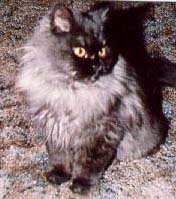
This Black Persian long hair cat
requires daily grooming to ensure that the hair stays in mat free
beautiful condition.
Source: Washington State University
Cats generally bathe themselves and do not need to be given baths. You will only need to bathe your cat if she gets something poisonous on her skin, if she gets particularly dirty for some reason (being caught outside in bad weather, for instance), or if for some reason she does not groom herself. If you do need to bathe your cat, groom her hair before the bath. Water will tighten any mats already in the coat. After your cat has been washed and dried, you can brush her hair again.
Choosing the Right Cat Grooming Brush and Comb
You’ll need the right tools for long hair cat care. In general, the wider and longer the hair, the more the bristles need to be space. Also, the coarser the hair, the stiffer the bristles.
 Pin
Type Cat Brush: (with or without rubber tips)
Pin-type brushes work well with or without rubber tips for cats with
long or thick fur or woolly coats. A dual brush has a pin brush on one
side and soft bristle on the other.
Pin
Type Cat Brush: (with or without rubber tips)
Pin-type brushes work well with or without rubber tips for cats with
long or thick fur or woolly coats. A dual brush has a pin brush on one
side and soft bristle on the other.
 Soft
Bristle Brush: For long, silky fur, soft
bristle brushes work best. They are good for most hair types. Use wider
spacing of bristles for longer hair cats.
Soft
Bristle Brush: For long, silky fur, soft
bristle brushes work best. They are good for most hair types. Use wider
spacing of bristles for longer hair cats.
 Slicker
Brush: Cat slicker brushes are comprised of
fine wire bristles. They are helpful with mats and any smoothing out
any tangling.
Slicker
Brush: Cat slicker brushes are comprised of
fine wire bristles. They are helpful with mats and any smoothing out
any tangling.
 Furminator
deShedding Tool: The Furminator is one of the most popular cat
tools. It is designed to easily catch and remove loose undercoat hair.
It is highly recommended for long hair cat care. The manufacturer
claims that the deShedding tool reduces shedding by 90%.
Furminator
deShedding Tool: The Furminator is one of the most popular cat
tools. It is designed to easily catch and remove loose undercoat hair.
It is highly recommended for long hair cat care. The manufacturer
claims that the deShedding tool reduces shedding by 90%.
 Grooming
Shedding Comb: You can follow up with a metal
comb such as a flea comb. The flea comb can help you work out any mats
in the hair and will also show you if your cat has any fleas. Combs are
good for everything, except wiry hair. They help with small knots of
hair. For more severe knots or mats, you need to use a mat breaker.
Grooming
Shedding Comb: You can follow up with a metal
comb such as a flea comb. The flea comb can help you work out any mats
in the hair and will also show you if your cat has any fleas. Combs are
good for everything, except wiry hair. They help with small knots of
hair. For more severe knots or mats, you need to use a mat breaker.
 Rubber
Massager Curry Brush : Rubber brushes are good for
massaging the skin on smooth coated cats and for removing dead hair.
They are are great way to
finish, massage and stimulate the skin to produce natural oils after
using other brushes.
Rubber
Massager Curry Brush : Rubber brushes are good for
massaging the skin on smooth coated cats and for removing dead hair.
They are are great way to
finish, massage and stimulate the skin to produce natural oils after
using other brushes.
How to Remove Cat Hair Mats
If there are mats in the hair (regular grooming should prevent these, but if you get off-track they may occur) do not cut them out, because it is easy to accidentally cut your cat’s skin and injure her. Instead use your fingers to pull the mats apart. Follow this with the use of a metal comb and brush or by using a Furminator as described in the video above. Inspect your cat for mats several times a week in order to prevent them from forming and because skin infections can occur beneath the mats if they are left in.
If you have more than one cat, clean the brush or comb after grooming one before moving on to the next. That way if one cat is developing any kind of skin infection or problem, you make sure not to spread it around.
Natural Remedies and Supplements for Cat Hair Care
Several systems in the body, such as the liver and skin, play a role
in the appearance of cat hair. One approach to help cats naturally
support these systems is the use of a homeopathic supplement formulated
to specifically enable the cat's natural processes to improve hair
appearance. Products such as Skin
and Coat Tonic contain ingredients such as Equisetum arvense,
a well known herb for tissue support, and Dandelion, a natural source
of vitamin A, D, C, B and iron.
References for Long Hair Cat Care:
Choosing and Caring for Your New Cat
Cornell University Feline Health Center
Cornell
University College of Veterinary Medicine
Brushing Through Cat Combs - Hartz
Have a Kitten or Cat Hair Care, Grooming or Health Question for Our Vet?
Do you have a question for our Vet about cat hair. We'll answer it for free!
Please include information such as cat age, breed, medications, diet, changes in behavior, anything that might trigger cat anxiety such as a change of home or the addition of a new pet, concern with your cat's hair or skin, medical history and other details which could be of help.
Our ability to respond quickly is based on the number of questions we receive. If you have an urgent question we suggest using this online veterinary cat answer service that is staffed by vets and available 24 hours a day. You only pay a small fee for answers you accept.
If the condition is visible please upload a picture to help our Vet provide a more complete answer.
