Flea Dermatitis Cat
"Flea dermatitis cat refers to a cat skin reaciton to fleas. It is an allergic reaction to this common feline parasite. The most pronounced symptom is itching which can open the skin to infection causing organisms. Fleas tend to reside on areas sof the cats body that can't be easily reached with the claws including at the tail, the cat's belly and back. Treatment involves using a product that removes them from the cats body and the cats envionment. Treatment is accomplished with products such as sprays, dips, spot-ons and shampoos. Homes are cleared of fleas using a disinfectant or by calling in an exterminator."
Flea dermatitis cat disorder is an inflammation of your cat’s skin due to fleas (C. felis felis). The cat flea, Ctenocephalides felis, is the most common parasite to harm the skin. It occurs when your cat has an allergic reaction to flea bites. While all cats are bothered by fleas, some cats are actually allergic to the saliva of fleas, referred to as flea bites.
The continual prevention of cat fleas can prevent many illnesses that the fleas cause including tapeworm, anemia (low red blood cell count, a threat in kittens) and a skin condition called feline miliary dermatitis.
A flea is approximately 1/8 inch long (size of a pinhead). They can jump as far as 7 feet, making it easy for them to leap onto a cat. A female will alternate between laying several eggs at 1 per hour and drinking blood meals. This can go on for months. 20,000 eggs can be layed over a 2 month period. It takes a month for an egg to go through the flea lifecycle and become an adult.
It is a good idea to groom your cat regularly, and grooming
sessions are a good time to check for any skin problems such as fleas.
Flea Dermatitis Cat Symptoms
Symptoms of flea dermatitis cat disorder include small red bumps and red, inflamed looking skin. The fleas tend to congregate in areas the cat can't scratch such as the back of the neck and the top of the tail head. Other areas where the red crusty bumps are seen include the groin, behind, lower back, thighs, abdomen, head and neck.
When a flea bites it can be very uncomfortable for your cat due to severe itching. When trying to scratch the itch your cat can open a skin wound which makes your cat vulnerable to infection.
Flea Dermatitis Cat Diagnosis
To find out if your cat has fleas, use a flea comb (a
fine-toothed comb) and comb her, looking for fleas and flea dirt
(feces). Flea dirt will look like dark specks. They will turn red if
you get them wet, because they are composed mainly of digested blood.
You might want to set your cat on a sheet of white paper, because fleas
and flea dirt will show up well against the white paper as they fall
off of her when you comb her.
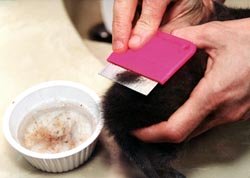
Picture Flea Comb
Your cat will probably also be scratching herself a lot.
Excessive scratching is often a sign of skin problems. If she is
scratching enough, you may notice sores on her skin or even some hair
loss.
Your vet will be able to diagnose flea dermatitis cat disorder
by looking at your cat’s skin and checking her for fleas. It is an easy
diagnosis to make. If if the fleas are no longer present on your cats
skin, your veterinarian may treat your cat for fleas and then watch the
treatment approach selected to see if their is any improvement.
Flea Dermatitis Cat Treatment
Treatment for cat fleas is highly effective.
Flea dermatitis cat disorder is fairly easy to treat. First your cat will need to be treated for fleas. We prefer the use of a herbal dip such as Dermisil as it will kill the fleas and provide some residual protection. This product in particular helps the treatment process as it mixes with your cats current shampoo or you can mix with the herbal shampoo made by the same manufacturer.
To interrupt the flea lifecycle and prevent future problems a spot-on product such as Frontline PLUS for Cats (spot on) can be used.
Once the fleas are gone, your cat’s rash should clear up.
However, she may continue itching for a while. If this is the case, a
short course of steroids can be prescribed. It is important that she
does not keep scratching herself because she may damage her skin. If
your cat's skin is irritated you can try a natural skin remedy designed
to sooth flea bitten skin such as
FleaDerm for Flea Bite Dermatitis.
If she has already damaged her skin, she may have developed a
secondary bacterial infection. If this is the case, oral antibiotics
will be prescribed.
Flea Dermatitis Prevention
The most effective way to prevent fleas is to provide your cat with protection throughout the year. Look for products that are applied monthly and contain selamectin or imidacloprid/moxidectin. Brands include:
Prevention Of Flea Dermatitis |
|
|---|---|
|
Products for Feline Flea Treatment and Prevention |
Active Ingredient and How it Works |
|
Fiponil and S-Methoprene. Interrupts the entire flea life cycle. Also protects against ticks. |
|
|
Contains imidacioprid which kills adult fleas and flea larvae (eggs). Stops flea bits in 5 minutes and kills 98% of fleas within 12 hours. |
|
|
Contains Etofenprox and methoprene. It kills young fleas and adult fleas. Also helps repel ticks and mosquitoes. Do not use on kittens under 12 weeks of age. |
|
Do not use a spray and a topical preventative product together. Only use products that specifically say they are safe for cats.
You also need to remove the fleas from your cat's indoor environment with a product made for this purpose such as Benzarid. Be sure to wash all of the cats belongings and thoroughly vacuum the house. To help with the removal of fleas from carpet try a product like Fleabuster RX. If necessary a profeesional exterminator can be called in. We suggest calling Terminix as they provide free on-site inspections and a free quote (phone 877-291-4849).
References:
Total Parasite Control - Piecing the Puzzle Together
M.W. Dryden
College of Veterinary Medicine, Kansas State University, Manhattan, KS,
USA.
College of Veterinary Medicine
