Feline Miliary Dermatitis
Feline miliary dermatitis is sometimes called “feline eczema” or “scabby cat disease.” Feline, of course, means cat. Dermatitis means skin inflammation. We use the word miliary because the skin lesions resemble millet seeds.
Feline miliary dermatitis is not a disease in itself, but a group of symptoms. These symptoms can be caused by a number of things, including:
-
Allergies
-
Autoimmune diseases
-
Bacterial infections
-
Fleas
-
Fungal infections
-
Hormonal abnormalities
-
Parasites, such as mites or lice, or intestinal parasites
-
Yeast infections
Feline Miliary Dermatitis Symptoms
Feline miliary dermatitis looks like small crusty bumps with red skin underneath. They may be confined to a small area of the body or may cover a large area. They can be very itchy, so your cat may scratch or lick the area a lot.
Pictures of Cat Miliary Dermatitis

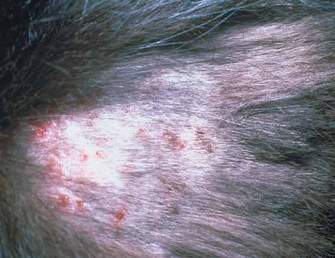
Feline Miliary Dermatitis Diagnosis and Treatment
Your vet will probably be able to diagnose feline miliary dermatitis just by looking at your cat’s skin. The challenging part, however, is figuring out the cause of the problem. The treatment of feline milary dermatitis depends upon the cause.
The location of the rash will give your vet a clue as to the cause. If the bumps are located near the base of the tail, fleas are a likely culprit. Your vet will use a
Cat Flea Comb to check for fleas and flea dirt (feces). If fleas are discovered, a flea treatment will be administered. This may be a spot-on treatment such as Frontline or a pill like Capstar, which acts more quickly.
If the rash is around the head, it is more likely caused by mites. Medications can be provided by your veterinarian to treat most kinds of mites.
Ringworm can be found anywhere on your cat’s body. It is treated with both oral and topical medication. You should know that you can catch ringworm from your cat, so you may need to be treated for it as well.
A stool sample may be tested to check for intestinal parasites. If any are found, oral medication for them will be prescribed.
If your cat’s rash is caused by a bacterial or yeast infection, she will be given antibiotics or an anti-fungal medication. She may also be bathed in a special shampoo to treat the yeast infection.
If food allergies are believed to be the cause, your cat will be placed on a special diet. It is difficult to determine whether allergies really are the cause or not until you see if the condition clears up in response to the special diet, so it can take a few months to see what happens.
Feline miliary dermatitis can be extremely itchy. If your cat has been scratchy or licking herself a lot, your vet may prescribe medication for the itching. In severe cases, she may have a secondary bacterial infection due to the scratching. This will be treated with antibiotics.
Sources:
Feline Miliary Dermatitis
Holly Nash, DVM
The Cat with Miliary Dermatitis
R.S. Mueller
Department of Clinical Sciences, Coll. of Veterinary Medicine & Biomedical Sciences, Colorado State University, Fort Collins, CO, USA.
From Feline Miliary Dermatitis to More on Cat Skin Problems
To Cat Health Guide Home
