Causes of Cat Allergy Symptoms
"Cat allergy symptoms includes skin conditions, hair loss, respiratory problems such as sneezing and gastrointestinal or stomach problems. Skin issues are most common with symptoms such as excessive grooming, skin inflammation, hair loss, feline acne, eosinophilic plaques (large red skin lesions) and granulomas. Respiratory problems include asthma, sneezing, nasal discharge, and watery eyes. The most common cause of skin allergies are fleas, followed by contact dermatitis, atopy (inhaled or seasonal allergy such as pollen) and food allergy. A veterinarian will base an initial diagnosis on the location and pattern of skin or hair loss, and symptoms such as gastritis, diarrhea or vomiting."
Cat allergy symptoms usually effect the skin. It is less
common for allergies to cause stomach problems such as vomiting and
diarrhea. Common causes include reaction to fleas (flea bite
hypersensitivity), scabies due to mites,
and emotional problems (psychogenic alopecia).
To identify the cause of the cat allergy symptoms affecting your cat:
- Start by reviewing the descriptions and pictures of
the feline allergy symptoms listed below.
- Then review the various causes and the related symptoms.
- If you still don't know the cause, fill out this form
and our Vet will comment for free. Please include pictures of any skin
condition. If you would like an immediate answer, we suggest using this
online
veterinary service which has Vets on call 24 hours a day.
Quick Guide to Cat Allergy Symptoms and Possible Causes |
||
|---|---|---|
|
Cat Allergy Symptoms |
Cat Allergy Related Cases |
Other Possible Causes of Cat Symptoms |
Watery diarrhea, with or without vomiting, no weight gain, slow weight gain |
Food Allergy |
IBD or Inflammatory Bowel Disease), Parasites, Infection |
Itch and scratching on head and ears, rubbing face on furniture, irritated cat skin from rubbing |
Food Allergy |
mange, ear mites |
Blood from rectum |
Food Allergy |
parasites, foreign object, infection or tumor |
Straining when moving bowels |
Colitis due to food allergy |
Parasites, eating household or outdoor plants, Tumor |
Vomiting |
Allergy to food not normally eaten |
Eating houseplants, dietary change, ingested human medication, swallowed foreign object such as a piece of thread, outdoor cats can ingest food that is tainted with salmonella, |
|
Respiratory problems such as cat reverse sneezing or cat unable to catch breath, repeated snorting, rapid breathing through nose |
Pharynx irritation due to allergy (try feeding cat soft foods to see if better |
Sore throat (may require veterinary care including antibiotics and anti-inflammtories |
|
Small scabs along back and head, hair loss along back, itch |
Flea allergy dermatitis or food allergy |
Condition called miliary dermatitis |
|
Progressive cat hair loss on legs and groin, Licking hair out |
Allergy |
Stress |
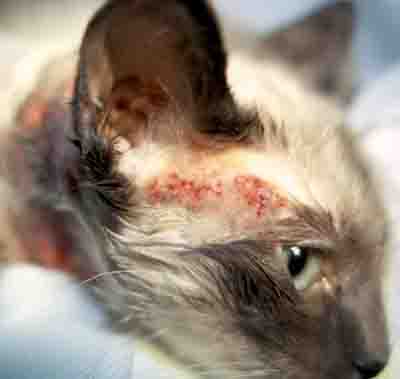
Cat Allergy Symptoms (feline facial allergy dermatitis)
Source: Washington State University, Dr Barbara Stein
Cat Skin Allergy Symptoms:
There are 4 general patterns that define the type of
skin allergy your cat might be suffering from. These include:
- Cat Miliary Dermatitis: Clusters of
red lesions on the skin that are usually found on the back.
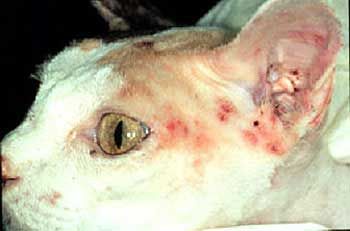
Cat Miliary Dermatitis due to Ringworm
Source: Wikipedia, Opera propria
- Feline symmetrical alopecia: Areas
where the hair has fallen out or the hairs look like they have broke
off in a specific area.
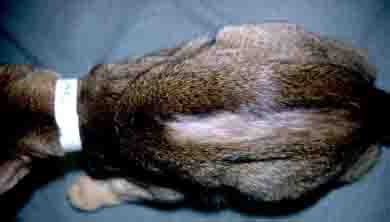
Cat Alopecia on Dorsal side of Cat
Source: Washington State University
- Eosinophilic granuloma complex: A
patch of itchy skin that can be found on the rear legs or the abdomen.

Chronic granulomatous dermatitis in a 3-year-old spayed female
Source: Washington State University
- Eosinophilic Granuloma: Allergic
reaction on your cat's lips.
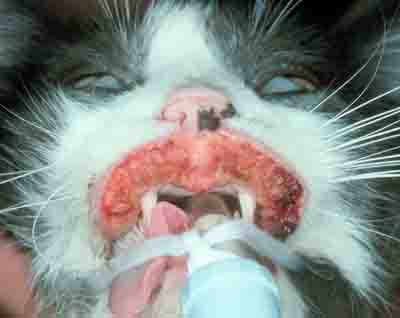
Cat Eosinophilic Granuloma on Lips
Source: Washington State University
- Pruritus: Another term for itch that
is usually on the face or neck. It is usually caused by food allergy.
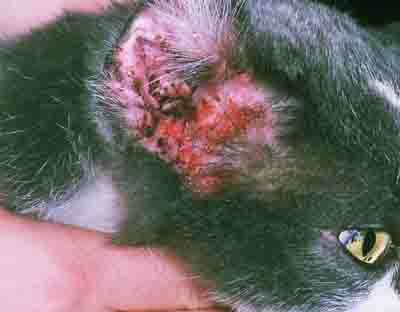
Cat Allergy Symptoms from Food
Source: Washington State University
For pictures and help with these cat allergy symptoms see our guide to feline skin allergies.
Natural Remedies for Cat Skin Allergy Symptoms:
It is important to see a veterinarian to help identify the underlying cause for your cat skin allergy problem. Natural remedies might also be of help. Certain herbs such as Althaea officinalis root (marshmallow) is an excellent and well-known remedy for soothing the skin – while Melaleuca alternifolia can be used externally for promoting skin health and keeping the skin clean. Remedies such as Ledum and Apis have good soothing properties and are particularly useful in soothing inflamed and irritated skin, or minor stings and wounds. One product to research if this approach is of interest is Wound Dr. which can help with ulcerated skin conditions.
Cat Food Allergy and Food Intolerance Symptoms:
Food
allergy occurs when the body's immune system reacts to a specific
food component (there are 40 ingredients in the typical commercial cat
diet). There is a difference between and food intolerance and a food
allergy. Food intolerance happens when the body is sensitive to a
particular food. Allergic reactions tend to be less severe than
intolerance.
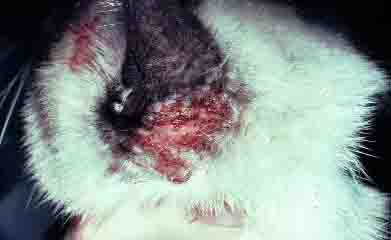
Cat Food Allergy Symptoms on Feline Ear
Source: Washington State University
Symptoms associated with food allergy and food intolerance include:
- Severe itch (16% of cats)
- Diarrhea and Vomiting (61%)
- Hair Loss (25%)
Even though your cat is eating the food and you would expect a reaction that is related to digestion, for some reason that researchers don't understand, the skin has a reaction. Gastrointestinal issues are only seen in 33% of cats suffering from allergy and food intolerance.
Food allergies tend to be the same across cats of different breeds, male or female. Reactions tend to occur more often in younger cats, but can be seen at any age.
Common cat allergy symptoms include itch on the face and neck (pruritic facial and neck dermatitis) or ears. In this type of allergic reaction you will notice crusty skin, eroded skin, and ulceration (patches of skin that look different than the rest of the skin and look like it has been worn away).
Other symptoms include hair loss (traumatic alopecia), usually due to your cat over grooming, miliary dermatitis (skin with collections of pronounced red bumps), eosinophilic plaques (well-defined, raised, ulcerated and extremely pruritic lesions that occur on the skin of cats, usually on the abdomen or hind legs) and scaling and shedding of the skin and usually accompanied by redness (exfoliative dermatitis).
Flea Bite Allergy Symptoms (flea-bite dermatitis)
Symptoms of an allergic reaction to cat flea bites
include itch and raw skin from scratching. Skin conditions are called
eosinophilic plaques (well-defined, raised, ulcerated and extremely
pruritic lesions that occur on the skin of cats, usually on the abdomen
or hind legs).
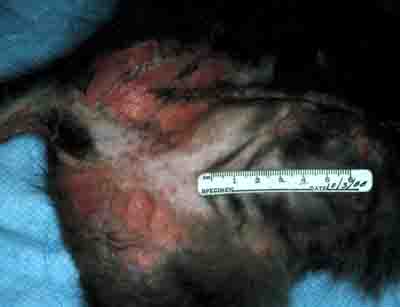
Cat Flea Allergy Symptoms called Eosinophilic plaques which form as a result of itching or scratching from cat flea allergy
Source: Washington State University, Dr Barbara Stein
Symptoms are usually seen during warm weather at the peak heat of the summer. If fleas are in the house you could see symptoms year round.
Swollen Head Allergy (urticaria)
This condition is caused by an allergic reaction to food. You will see swelling around the eyes and face, which may even cause the eyes to be swollen shut. Other causes are due to a reaction to an insect. A reaction can happen fast.
Your cat may be helped by a cold compress or a medication such as antihistamine. An over the counter product may be recommended such as benadryl. The dosage is 1 to 3 milligrams per pound of your cat, however, you should only do this if you check with your veterinarian first to ensure that the product is safe for your cat and the dosage is correct.
Hay Fever
Like humans, cats can suffer from environmental allergies such as hay fever. Common cat allergy symptoms aren't that different from humans with a runny nose, red eyes and sneezing.
You can help your cat by providing a bath made with colloidal oatmeal. Your cat may also be helped with an antihistamine such as benedryl as described above.
Heavy Breathing/Sinus Problems
If your cat is breathing heavily and your veterinarian cannot determine a physical cause, you can also try a natural remedy designed to help support the sinuses. One product to research is Sinu-Rite which is a proven herbal cat sinus condition solution.
References for Cat Allergy Symptoms
Feline Allergic Skin Disease – What’s New in Diagnosis
and Management?
Peter Hill
BVSc, PhD, DVD, Dip. ACVD, MRCVS
Senior Lecturer in Veterinary Dermatology
Division of Companion Animal Studies,
Department of Clinical Veterinary Science,
University of Bristol,
Langford, Bristol, UK
Adverse Food Reaction in Cats
Dr. T. Willemse
Utrecht University,
Faculty of Veterinary Medicine,
Department of Clinical Sciences of Companion Animals,
Utrecht, the Netherlands
Have a Cat Health Question or Want to Share a Story that could help others?
Can't find the information you need or want to share a story that will help others? Send in your cat health question or describe your cat's health care issue and we will do our best to send a reply. One question will be selected each week.
Be sure to include helpful information such as breed, age, sex and medical history including medications, lifestyle (indoor or outdoors) and other information you think might be helpful such as any recent diagnosis.
We will try and respond as quickly as possible. If you have an urgent cat health question we suggest using this online veterinary cat answer service that is staffed by vets and available 24 hours a day. You only pay a small fee for answers you accept.

The Cat Health Guide is not intended to replace the advice of a Veterinarian or other Health Professional.
This site accepts advertising and other forms of compensation for products mentioned.
Such compensation does not influence the information or recommendations made.
We always give our honest opinions, findings, beliefs, or experiences.
All rights reserved. © 2021 Cat Health Guide.