Identifying Ringworm Symptoms in Cats
"Ringworm Symptoms in cats usually appear as round hairless areas which surround red scaly skin. It looks as if a skin area has been shaved. Symptoms usually appear on the face, ears and paws. At first skin pustules (pus filled pimples) are observed, followed by lesion crusting. It is possible to have ringworm lesions without hair loss or for cats to be a carrier of ringworm fungus spores without showing any symptoms. Diagnosis is based on taking a fungal culture in a veterinarian's office. Treatment involves the use of anti-fungal topicals or medications. Ringworm can be spread from cats to other animals and people."
Ringworm symptoms in cats (also known as Dermatophytosis and Dermatomycosis) is caused by a fungal infection that can be contracted by coming in contact with fungal spores in the ground, in your home, on a human or another animal. It can be found on any part of your cat's body. Common areas are around the face and ears and the paws.
Symptoms are most often seen in young cats, or cats with risk
factors such as a depressed immune system. The disease requires a trip
to the veterinarian so
that a course of treatment can be determined.
Symptoms of Ringworm in Cats
Ringworm symptoms in cats can vary quite a bit, but usually is characterized by a growing circular area of hair loss (alopecia) which surrounds red or gray crusty lesions or scabs on the skin.
It may appear as if you cat has dandruff or acne on the chin. Your cat may be tempted to lick or scratch the affected area due to itch that sometimes accompanies the problem. Itch is not a common symptom.
Symptoms can also appear as irregular hair loss,
deformed toenails, areas of red or dark sin and small scabby bumps.
Hair may also be brittle in places with broken hairs as the visible
symptom.
Ringworm will get worse over time if not treated.
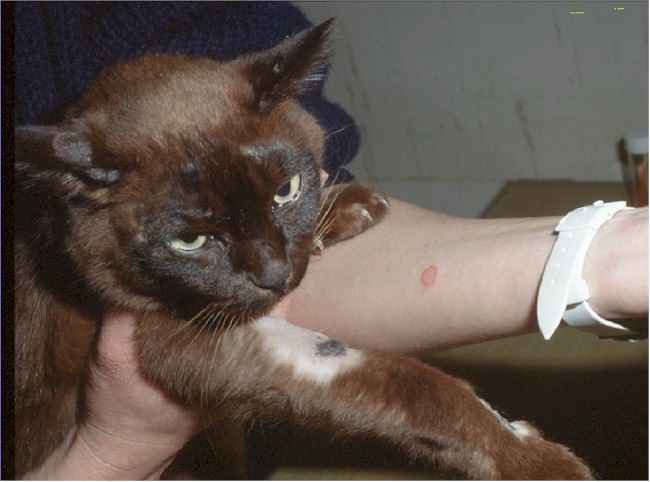
Picture of Cat Ringworm Symptoms
Normal cases of ringworm take
from one to three months to heal.
Diagnosing Ringworm Symptoms in Cats
Your veterinarian can perform several tests to determine if your cat has ringworm including looking at the skin under a special light or examination of hair or skin samples under a microscope.
Cats Without Ringworm Symptoms
It is possible for a cat to be a carrier of the
ringworm fungus without showing any symptoms.
Treating Ringworm Symptoms in Cats
Your veterinarian has a choice of oral prescription medications for ringworm (griseofulvin), topical ointments and dips. Note that some cats do not react well to griseofulvin. Since treatment of ringworm can be a lengthy process, be sure to discuss any kind of treatment option with your veterinarian.
Other medications for ringworm include topical ointments. These may not be effective since your cat will try to lick it off if it is used on a part of the body that is accessible to your cat. First clean the area to be treated with Betadine Solution or a natural skin cleaner made for pets such as Clenzor. Next use the prescribed topical ointment or a natural topical treatment made specifically to help cats with ringworm. Prescription or natural treatment may be a good choice for smaller cases that are in one area (localized).
Lime Sulfur dips such as Naturasil for Ringworm are considered to be highly effective for treatment. This combined with oral medications may be all your cat needs for fast treatment.
Other approaches such as povidone-iodine (Betadine) or chlorhexidine shampoo may not work as quickly.
Remove Fungal Spores From the Environment
To prevent re-infection you will need to thoroughly clean the area where your cat lives. First vacuum the entire area to pull up the fungal spores and fungus that is living on cat hair that fell off of your cat. Next use a disinfectant such as Benzarid which contains benzalkonium chloride, a highly effective cleaner for this problem.
Everything should be cleaned including cat blankets, sleeping areas, leash and collar.
Also change any air filters in your home air conditioning or heating system.
Ringworm fungus can survive for up to 4 years so
cleaning is essential.
References:
The Well Cat Book: The Classic Comprehensive Handbook of Cat Care
McGinnis,
Terri, DVM
Ringworm Infection in Dogs and Cats
R. A. Cervantes Olivares
Departmento de Microbiologica and Immunologia
Unversidad nacional Autonama de Mexico
Have A Question about Ringworm in Cats?
Do you have a question for our veterinarian about a cat ringworm problem? Share it and our veterinarian will answer it for free!
If possible, please include a picture. Seeing the skin problem can help us improve suggestions made. Please include information such as breed, age, sex, history, changes in behavior, products used etc.
We will try and respond as quickly as possible. If you have an urgent question we suggest using this online veterinary cat answer service that is staffed by vets and available 24 hours a day.
What Other Visitors Have Asked and Vet Responses
Click below to see contributions from other visitors to this page...
Stop The Spread Of Ringworm 
Reader Question: How To Keep Ringworm In A Cat Confined
I found a cat a few months ago who I think was dropped off and she was starving. She put …
Removing Ringworm From Cat, Person & Environment Not rated yet
Reader Question: Removal of Ringworm
Our house already had 16 pets when the formerly feral shelter cat that belonged to my 30+ daughter-in-law …
