Causes, Symptoms and Treatment of Cat Skin Allergies
"Cat skin allergies have multiple causes including parasites such as fleas, atopy or inhaled allergens, skin contact irritants and food allergy. Determining the cause starts a review of where and how the condition manifests itself on the skin. Location and pattern of hair loss are important clues as to the possible underlying cause. A veterinarian will eliminate potential triggers one by one until a specific diagnosis is reached. The first step is to eliminate fleas, since this is the leading cause. If a cat is on a flea preventative, the Vet will look for signs of food allergy, contact allergens in areas with less hair such as the abdomen, face, feet and neck, and food allergy. Treatment involves eliminating the allergic trigger such as changing the cat's diet or treating for fleas. If allergy is eliminated as the cause of a skin problem, other autoimmune conditions such as pemphigus are considered."
Cat skin allergies are usually categorized into the following broad descriptions:
- Fleas
- Atopic Dermatitis (a wide range of skin diseases associated with stress and allergic disorders that involve the respiratory system)
- Food Allergy
Genetics or breed type has not been shown to play a role
since allergic
response is an immune system disorder where the cat has an abnormal
reaction to a non-toxic substance. Allergic reactions often start on
the skin and then result in itch several hours later. The itch itself
causes scratching which can result in additional skin complications
such as lesions and bacterial infection.
Appearance of Cat Skin Allergies
There are many different ways a feline skin allergy will
appear on your cat. Because of this, your veterinarian will try and
diagnose your cats skin condition by trying to place it into one of 4
groups or patterns. While a pattern isn't a definite diagnosis, it
provides a clue as to what cat skin disease and condition is troubling
your cat.
Cat Miliary Dermatitis (papulocrustous dermatitis):
This skin condition is usually found on your cat's back, but can be
located on any part of your cat's body. It is often seen with other cat
skin conditions such as allergic reactions to flea bites.
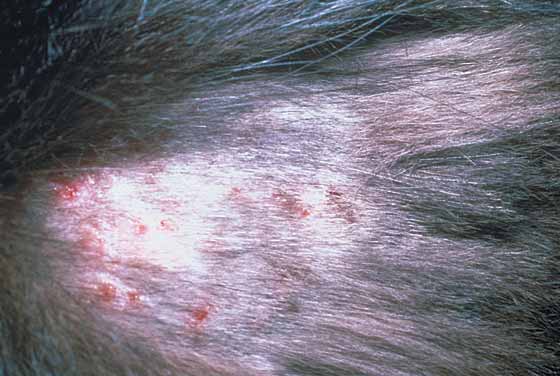
Picture of Cat Skin Allergy - Miliary Dermatitis
Feline symmetrical alopecia: Cat's with
this skin allergy has spotty areas with short stubby hair. Your cat may
be licking out its hair (it will appear as if your cat's hair is
falling out). The condition is usually seen on your cat's belly, rear
legs and sides of the lower abdomen. The condition usually does not
appear on the back.
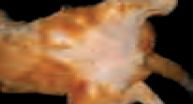
Picture of Cat Skin Allergy - Feline Symmetrical Alopecia
Eosinophilic granuloma complex: There are several causes of this condition including:
- A slow growing ulcer (indolent)
- Eosinophilic Plaque: well-defined, raised, ulcerated and extremely itchy (pruritic) lesions that occur on the skin of cats, usually on the abdomen or hind legs)

Picture of Cat Skin Allergy - Eosinophilic Plaque
Eosinophilic Granuloma: collective name
given to the lesions (diseased patch of skin) of eosinophilic ulcer
(break on your cat's lip), eosinophilic plaque (lesions on the skin,
usually on the abdomen or hind legs), and linear granuloma (small
nodules on the skin). This is usually caused by an allergic reaction to
something in your cat's environment, fleas and food.
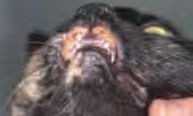
Picture of Cat Skin Problem - Eosinophilic Granuloma Complex
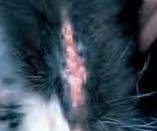
Picture of Cat Skin Condition - Eosinophilic Granuloma Complex
Head and neck pruritus (itching): This is
a condition that causes your cat to scratch the head and neck. You will
see areas of hair loss and skin damage due to scratching. You might
also see breaks in the skin and cheeks. Some veterinarians believe this
condition is caused by an infection from the herpes virus after your
cat has received a vaccine.
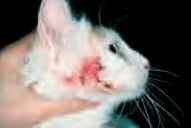
Picture of Cat Skin Allergy - Head and Neck Pruritus
Some cats may have more than one of the conditions described above. It
is also possible to have itchy skin without being neatly categorized.
The skin patterns shown can appear with many of the causes described
below.
If your cat's skin allergies are mostly on the face,
then diet is a likely cause. Other signs or problem with digestion may
appear with the skin symptoms which confirm food as the underlying
problem. Foods such as fish, lamb and dairy are common culprits of a
cat food intolerance problem.
Causes of Cat Skin Allergies
If your cat's skin condition fits into one of the patterns listed above, then the following conditions may be causing the problem:
- Cat Skin Allergies
- Flea Allergy
- Atopic Allergy (sensitivity to the environment)
- Food
Allergy
- Parasite Problem
- Lice
- Otodectes cynotis
- Cheyletiella spp.,
- Trombicula spp and Demodex spp. (mites)
- Bacterial Infections
- Fungal Infections
- Unknown Cause (idiopathic)
- Caused by Behavioral Issues
Diagnosis of Cat Skin Allergies
To get to a definitive diagnosis, your veterinarian will start to treat the skin disease she thinks is causing the problem and then through a process of elimination find the exact cause.
Your veterinarian will start by looking for a parasitic reaction (fleas), followed by food intolerance (bad reaction to certain types of food).
To diagnose cat flea allergy your veterinarian will look
for evidence of fleas such as specks falling from your cat's body when
a flea comb is used. If fleas are suspected then products which kill
fleas will be recommended. Fleas are most likely to be found on the top
of the tail and neck.
Another parasite, mites in your cat's environment could cause an allergic skin reaction. The mite species Otodectes cynotis has been shown to cause this type of reaction.
To determine food intolerance your vet will eliminate most food groups and see how your cat does. New foods will slowly be added back in.Cat Flea Allergy.
If these causes are eliminated, your veterinarian may recommend skin allergy tests to determine which allergens in your cat's environment are causing the problem.
Treatment of Cat Skin Allergies
When an exact cause is identified, allergy shots can be used to reduce your cat's sensitivity to the allergen. Research has not fully supported the effectiveness of shots.
Antihistamines may be prescribed such as Chlorpheniramine and have been shown to be effective.
For food allergy or food intolerance, many veterinarians recommend home cooked food such as boiled chicken and rice. There are also Prescription Diets designed to assist with a food elimination approach. When changing your cat's diet, be sure to try the new diet at least 10 weeks before making a determination to give it time to take hold.
Homeopathic remedies (natural medicine) may offer an alternative to prescription approaches. Ingredients such as Equisetum arvense (Horsetail) contains silica which is an essential element of strong skin. Other such as Taraxacum officinalis (Dandelion) is a source of vitamins and minerals, including Vitamin A, D, C, various B Vitamins, iron, lecithin, silicon, potassium, magnesium, zinc and manganese. These vitamins soothe the skin.
One product made specifically to help with cat skin allergies is PetAlive Skin and Coat Tonic. Be sure to discuss this approach with your veterinarian so that he or she can track progress. The company is also a good source for further research.
References
Feline Allergic Skin Disease – What’s New in Diagnosis
and Management?
Peter Hill
BVSc, PhD, DVD, Dip. ACVD, MRCVS
Senior Lecturer in Veterinary Dermatology
Division of Companion Animal Studies,
Department of Clinical Veterinary Science,
University of Bristol,
Langford, Bristol, UK
Have a Cat Health Question or Want to Share a Story that could help others?
Can't find the information you need or want to share a story that will help others? Send in your cat health question or describe your cat's health care issue and we will do our best to send a reply. One question will be selected each week.
Be sure to include helpful information such as breed, age, sex and medical history including medications, lifestyle (indoor or outdoors) and other information you think might be helpful such as any recent diagnosis.
We will try and respond as quickly as possible. If you have an urgent cat health question we suggest using this online veterinary cat answer service that is staffed by vets and available 24 hours a day. You only pay a small fee for answers you accept.
